iHV welcomes and supports the Government’s national campaign urging expectant mothers to get vaccinated against flu, RSV and whooping cough to protect their babies this winter.

The Department of Health and Social Care campaign – ‘Stay Strong. Get Vaccinated’ – uses bubble wrap imagery to show how vaccination during pregnancy passes life-saving antibodies through the placenta to protect newborns.

It comes as the NHS ramps up preparations for winter to provide the safest possible care for patients, with local NHS leaders taking part in “stress test” exercises and providing targeted care for the most vulnerable.

Alongside this, patients are being urged to protect themselves and their families against winter viruses – to help take pressure off hardworking staff and ensure care is there for patients when they need it most.

Health Minister, Ashley Dalton, said:

“We urge expectant mothers to come forward for their flu, RSV and whooping cough jabs – it’s one of the most powerful ways to protect your baby through those critical first months.

“Winter is always tough for the NHS but we are working hard to ramp up preparations so the health service is ready for patients when they need it.

“Let’s work together to protect ourselves and ease pressure on our NHS – the single best way you can protect yourself and your family is by getting vaccinated.”

The multi-channel campaign supported by the UK Health Security Agency (UKHSA) and NHS England will be shown across TV, video on demand, radio, outdoor advertising and social media. A second phase of the campaign in October will aim to encourage people with long-term health conditions to come forward for flu vaccination.

Each year, some 600,000 women give birth in England. New data from the UK Health Security Agency (UKHSA) reveals hundreds of thousands of pregnant women missed vital vaccines last winter with:

  • just over a third (35%) vaccinated against flu
  • around half receiving a vaccination for RSV, since the programme was launched a year ago
  • a third missing their whooping cough vaccination (66% uptake, though this rose to 71% in early 2025)

Whooping Cough

With 12 infant deaths from whooping cough since the beginning of 2024 and hundreds of babies hospitalised from vaccine-preventable illnesses, it is vital that pregnant women receive their vaccine at the right time – ideally between 20 and 32 weeks.

If you are pregnant and approaching 20 weeks and haven’t been offered the whooping cough vaccine, please speak to your GP or midwife today to find out how you can get your vaccine.

RSV – Respiratory syncytial virus

That is why it is so important that pregnant women between 20 and 32 weeks ensure they are vaccinated as soon as possible – please speak to your GP or midwife today to find out how you can get your vaccine.

Flu

Since the start of September, pregnant women and millions of children have been able to get their flu vaccinations. As of 1 October, adults over 65, those at clinical risk and other eligible groups will also be able to get their flu jabs, with over-75s and those who are immunosuppressed able to get their COVID vaccine.

Those eligible should speak to their GP or practice nurse, or alternatively their local pharmacist, to book a vaccination appointment. For pregnant women, the vaccine may also be available through maternity services.


From 1 September 2024, there will be two new vaccination programmes against respiratory syncytial virus (RSV) – during pregnancy (for infant protection) and older adults in England, Wales and Northern Ireland, with the rollout in Scotland already commenced in August. The new vaccinations have been introduced following guidance from the Joint Committee on Vaccination and Immunisation (JCVI).

It is important that everyone working in health visiting is aware of the programme and the underpinning evidence, to support their work in promoting RSV vaccine uptake.

Why vaccinate against RSV?

RSV has been described as “maybe the most common virus you have never heard of” by GP and journalist Dr Mark Porter.

RSV causes respiratory illnesses which are most frequently seen over the winter months between November and February1. In the majority of people, it presents as a cough/cold which gets better by itself within 1 or 2 weeks2. However, in vulnerable populations, such as babies under 6-months-old, those born preterm, adults over 75 years and anyone with a weakened immune system, long-term lung or heart conditions, RSV can be much more serious requiring hospitalisation and, in some cases, causing death.

Many babies with RSV infection are undiagnosed, but they will struggle to breathe and feed due to bronchiolitis or pneumonia over the winter months. On average in England, 20,000 infants are admitted to hospitals each winter due to RSV. The vast majority have no underlying medical conditions. Many need intensive care, and sadly 20 to 30 will die due to RSV infection. RSV has wider impacts too, cancelling major paediatric surgery because critical care beds are needed to keep children with RSV breathing.

The maternal vaccine is a major step forward for child health. It offers infants 70% protection against severe RSV lower respiratory tract infection over the most vulnerable first 6 months of life. Commenting on the new vaccination programme, The Royal College of Paediatrics and Child Health has called it “game changing”.

The new RSV schedule – what you need to know:

  • Pregnancy
    • All women who are at least 28 weeks pregnant on 1 September 2024 should be offered a single dose of the RSV vaccine. After that, pregnant women will become eligible as they reach 28 weeks gestation and remain eligible up to birth. The ideal opportunity to offer vaccination would be at the 28-week antenatal contact, following prior discussion about the vaccine earlier in pregnancy. Providers should aim to vaccinate those already eligible on 1 September as soon as possible.
  • Older adults
    • All adults will be offered the vaccination at 75-years-old.
    • There will be a catch-up programme which will start for those aged 75–79-years-old on 1 September 2024.
    • They will remain eligible until the day before their 80th birthday, with the aim to complete the catch-up programme by the end of August 2025.

It is expected that the majority of the two population groups will have their vaccinations in September and October in preparation for the start of the RSV season.

Role of the health visitor

It is important that health visitors and their teams are aware of these new vaccination programmes. They are ideally placed to have conversations about the benefits of the maternal vaccination during the antenatal and interpregnancy periods, to ensure families who are pregnant or are planning a pregnancy are aware of the new RSV vaccination and how it protects babies. Through their extensive reach to millions of families across the UK each year, they can also play an important role in raising awareness of the new older adult vaccination programme for extended family members, or with grandparents helping with childcare. They are in the ideal place to explain to families what the new programme is, answer any questions that they may have, and direct them to the GP surgery for more information. This will help to protect the whole family, offering lifesaving protection against RSV for young babies and other vulnerable groups.

Further information, guidance and resources to support healthcare practitioners and raise awareness of the new RSV vaccination

As there are two new RSV vaccination programmes (one for pregnant women for infant protection and a separate one for older adults), there are different supporting resources available for each. It is important that anyone involved in RSV immunisation, or promoting vaccine uptake, is aware of which resources to use. More details are also available in the green book, chapter 27a: respiratory syncytial virus.

UKHSA and Public Health agencies for the devolved nations have produced several resources to support practitioners in raising awareness of the new programmes. Some of the resources are available in other languages. Follow the links below to access the resources.

References

  1. UKHAS (2024) What is RSV and is there a vaccine?. Available at: https://ukhsa.blog.gov.uk/2024/07/17/what-is-rsv-and-is-there-a-vaccine/
  2. NHS (2024) Respiratory syncytial virus (RSV). Available at:
    https://www.nhs.uk/conditions/respiratory-syncytial-virus-rsv/

From 1 September 2024, pregnant women can have a free vaccine in each pregnancy to protect their babies against respiratory syncytial virus (RSV). Make sure you are up to date about this important new vaccination to raise awareness and promote uptake.

Why the RSV vaccine is needed

RSV is a common virus which can cause a lung infection called bronchiolitis. In small babies this condition can make it hard to breathe and to feed. Most cases can be managed at home but around 20,000 infants are admitted to hospital with bronchiolitis each year in England. Infants with severe bronchiolitis may need intensive care and the infection can be fatal in some cases. RSV is more likely to be serious in very young babies, those born prematurely, and those with conditions that affect their heart, breathing or immune system.

RSV accounts for approximately 33,500 hospitalisations annually in children aged under 5-years-old. It is a leading cause of infant mortality across the world and results in 20 to 30 deaths per year in the UK. RSV infects up to 90% of children within the first 2 years of life and frequently re-infects older children and adults.

How the RSV vaccine protects babies

The vaccine boosts the mother’s immune system to produce more antibodies against the virus. These antibodies then pass through the placenta to help protect babies from the day they are born. RSV vaccination reduces the risk of severe bronchiolitis by 70% in the first 6 months of life. After this age, babies are at much lower risk of severe RSV.

Older children and adults can also get RSV infection, but the disease is more serious for small babies and people aged 75 and over.

Find out more: A guide to RSV vaccination for pregnant women

Read UKHSA Guidance:  RSV vaccination of pregnant women for infant protection: information for healthcare practitioners

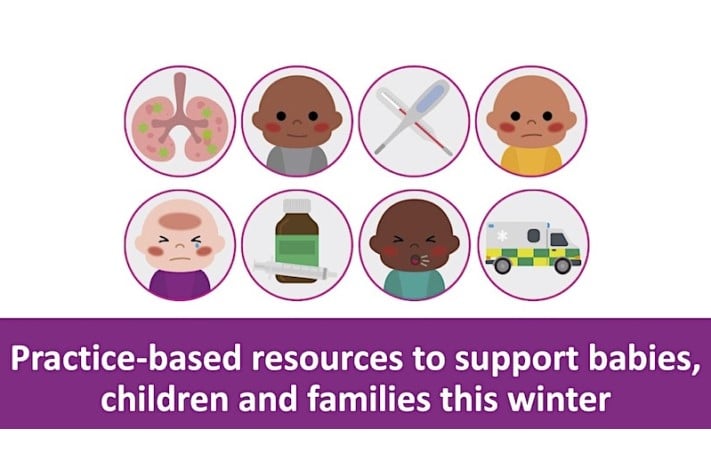
On Tuesday 16 January 2024, we delivered a Winter Illness webinar which aimed to refresh practitioners’ knowledge and to share the wide range of resources that we have available to help you support babies, children & families this winter.

The following updates were provided from partner organisations during the webinar:

  • Healthier Together provided an update from a Lead Paediatrician on the current winter illness context
  • Bliss Charity shared resources on recognition of illness in babies with Black and Brown skin
  • Barnardo’s discussed damp and mould and the impact this has on respiratory health

Babies under one year of age have the highest Emergency Department (ED) attendance rate, as highlighted in our recent report ‘Understanding the rise in 0-4-year-old Emergency Department (ED) attendances and changing health visiting practice‘. Respiratory illnesses represent 3 of the top 5 reasons for ED attendance and include: upper respiratory tract infections, tonsilitis and bronchiolitis. The report also highlighted that 59% of A&E attendees did not need investigations, treatment, or hospital admission, and were sent home after reassurance.

With this in mind, it is important for health visitors and other healthcare professionals to have knowledge and understanding of current respiratory illnesses, the signs and symptoms, and advice to be able to offer parents to help enable them to look after their children at home and know when to seek further help and support.

Over the last 3 years the iHV has been working closely with NHSE, Barnardo’s, Bliss, Contact and Healthier Together to create resources for parents and healthcare professionals about a variety of winter illnesses, which include:

  • Bronchiolitis and RSV
  • Croup
  • Difficulty breathing and wheeze
  • Fever, and fever under 3-months
  • Breathing difficulties in babies under 3-months
  • Strep A and Scarlet Fever
  • Flu

The related resources come in a range of formats – from e-learning and webinars for healthcare professionals/practitioners, to resources for parents including “When to worry” written resources, plus filmed and animated resources in the following languages: Bengali, Gujarati, Polish, Punjabi, Romanian, Spanish and Urdu, as well as English.

Babies under one year of age have the highest Emergency Department (ED) attendance rate, as highlighted in our recent report ‘Understanding the rise in 0-4-year-old Emergency Department (ED) attendances and changing health visiting practice‘. Respiratory illnesses represent 3 of the top 5 reasons for ED attendance and include: upper respiratory tract infections, tonsilitis and bronchiolitis. The report also highlighted that 59% of A&E attendees did not need investigations, treatment, or hospital admission, and were sent home after reassurance.

With this in mind, it is important for health visitors and other healthcare professionals to have knowledge and understanding of current respiratory illnesses, the signs and symptoms, and advice to be able to offer parents to help enable them to look after their children at home and know when to seek further help and support.

Over the last 3 years the iHV has been working closely with NHSE, Barnardo’s, Bliss, Contact and Healthier Together to create resources for parents and healthcare professionals about a variety of winter illnesses, which include:

  • Bronchiolitis and RSV
  • Croup
  • Difficulty breathing and wheeze
  • Fever, and fever under 3-months
  • Breathing difficulties in babies under 3-months
  • Strep A and Scarlet Fever
  • Flu

The related resources come in a range of formats – from e-learning and webinars for healthcare professionals/practitioners, to resources for parents including “When to worry” written resources, plus filmed and animated resources in the following languages: Bengali, Gujarati, Polish, Punjabi, Romanian, Spanish and Urdu, as well as English.

Webinar

On Tuesday 16 January 2024, 15:00-16:30, we are delivering a webinar which aims to refresh practitioners’ knowledge and to share the wide range of resources that we have available in more detail. Updates will be provided from each of the partner organisations:

  • Healthier Together will provide an update from a Lead Paediatrician on the current winter illness context
  • Bliss Charity will share resources on recognition of illness in babies with Black and Brown skin
  • Barnardo’s will be discussing damp and mould and the impact this has on respiratory health

Please join us for this important learning event and refresh your knowledge.

Webinar: Practice-based resources to support babies, children & families this winter
Date: Tuesday 16 January 2024
Time: 15:00-16:30
Online