The Institute of Health Visiting (iHV), in collaboration with ERIC – The Children’s Bowel & Bladder Charity, has launched a new Parent Tip on toilet training, offering clear, practical guidance for parents and carers to help babies and children move confidently out of nappies and develop healthy toileting habits.

Toilet training is a vital milestone in every child’s development – supporting independence, confidence, and school readiness. The new iHV Parent Tip highlights new messaging – that it is better for children’s bladder and bowel health to stop using nappies between 18 and 30 months.

The change in guidance is based on research and a consensus of leading experts in the field – moving away from previous advice to ‘wait until children are ready’. This advice is now outdated as modern nappies are designed to protect children from feeling wet and many will not show signs that it is the right time to stop using nappies.

In the 1970s and 1980s, 83% of children were out of nappies by 18 months – children haven’t changed, but society has. There is strong evidence that almost all children can learn to use the potty or toilet between 18 to 30 months – including most children with SEND, with the right support. Toilet training is about learning skills, and these can be taught. The longer you wait, the harder it can be. It is time to shift the dial back to the best evidence.

The iHV Parent Tip also supports the Government’s ambitious target for 75% of children to achieve a Good Level of Development (GLD) by 2028 – and this includes self-care skills like being able to use the toilet independently. Health visitors and health visiting teams are central to achieving this goal, and their vital work with families will support more children to be ready to be happy, healthy and ready to learn at school.

Georgina Mayes, iHV Senior Lead for Health Visiting Professional Services, said:

“The iHV Parent Tip on toilet training is a timely and practical resource that will help health visitors and health visiting teams support families through one of the most important milestones in early childhood. Helping children to come out of nappies between 18 and 30 months, not only promotes healthy bladder and bowel development, but it also supports confidence, independence and school readiness. Health visitors and health visiting teams are uniquely placed to share this Parent Tip with families, identify any early challenges, provide timely support and guidance, so every child can thrive.”

Siân Wicks, CEO of ERIC, The Children’s Bowel and Bladder Charity, said:

“The first 1001 days of a child’s life – from pregnancy to age two – are when the building blocks for lifelong emotional and physical wellbeing are laid down, and potty training is a key milestone during this period. Ensuring that children are out of nappies by 18 to 30 months is critical for their ongoing health, which is why ERIC is collaborating with the Institute of Health Visiting to provide guidance for families to ensure children are given the best possible support. It is essential that families, and the professionals supporting them, have the most accurate and up-to-date information, and in partnership with the Institute of Health Visiting we’re helping to ensure that happens and give every child the best start in life.”

The Toilet Training Parent Tip provides a simple step-by-step approach and is available to download from the iHV website here.

 

We are delighted share a number of updated Good Practice Points and Parent Tips resources:

Good Practice Point – Duchenne Muscular Dystrophy – recognition, diagnosis and clinical care

These Good Practice Points set out what health visitors need to know about the recognition, diagnosis and clinical care of Duchenne Muscular Dystrophy.


Good Practice Point – Recognition and Management of Hyperemesis Gravidarum

HG is a serious complication of pregnancy which requires active intervention and treatment. It is diagnosed when symptoms start in early pregnancy (before 16 weeks gestational age); nausea and vomiting is present, at least one of which severe; the ability to eat and drink normally is affected and activities of daily living are strongly limited.

This GPP provides up-to-date evidence and references.


Good Practice Point – Umbilical Granuloma

These Good Practice Points set out what health visitors need to know about the Treatment of Umbilical Granuloma.

This GPP provides up-to-date evidence and references.


Good Practice Point – Working with prisoners’ families

Every year around 310,000 children experience the imprisonment of a parent in the UK, which is more than the number of children affected by divorce. Prisoners’ partners, children and other family members often feel lonely, stigmatised and unsure where to turn for help, support, advice and information. Health Visitors can play a key role in supporting prisoners’ families, and in helping family members access useful services and sources of advice. These Good Practice Points set out what health visitors need to know about working with Prisoners’ Families.


Good Practice Point – Postpartum psychosis

Postpartum psychosis (PP), also known as puerperal psychosis and postnatal psychosis, is a severe illness that involves hallucinations, delusions, mania, severe confusion, or unusual behaviour occurring, often with acute onset, in the postnatal period.

These Good Practice Points set out what health visitors need to know about Postpartum Psychosis.


Good Practice Point – Supporting good practice with toilet training

Health visitors have an important role in supporting toilet training for all children and assisting school readiness. Toilet training involves important skills that HVs can promote and discuss with families, regardless of the child’s ability.


Parent Tip – Toilet Training

Toilet training is about your child learning a set of skills. Making the transition from nappy to potty, or toilet, can result in a sense of achievement for you both.


Parent Tip – Childhood Cancer: spotting the signs & symptoms

Childhood cancer is rare, but it does occur more frequently than most of us think. It may come as a surprise, but cancer is one of the biggest medical causes of death in children in the UK. Statistically, 1 in 450 children are diagnosed with cancer before they reach the age of 15. Every year, there are 4,000 children and young people diagnosed with cancer in the UK. Despite this fact, few of us are aware of the signs and symptoms.

The aim of these Top Tips is to make you aware of what to look for in your child to enable affected children to be diagnosed early. Early diagnosis of childhood cancer saves lives.


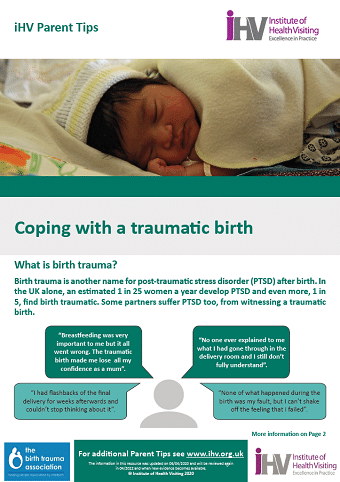
As part of UK Maternal Mental Health Awareness Week, iHV launches a new Parent Tip – Coping with a traumatic birth.

Developed with expert authors and the Birth Trauma Association, this Parent Tip explains what birth trauma is, the symptoms of birth trauma, how it is treated and where to get help.

Please share.


This Parent Tip joins our suite of Parent Tips  – our helpful factsheets to help parents to find expert advice on key areas of looking after their new baby from when they are born to when they go to school. Written by experts in the field, they cover topics such as feeding, health, behaviour and development, and are based on up-to-date research and the experience and knowledge of real-life health visitors working across the UK.