Today, the Department of Health and Social Care published its long-awaited policy blueprint for improving child and family health. The Healthy Child Programme (HCP) is the national framework for improving the health and wellbeing of children and young people aged 0 to 19 (age 25 for care leavers or those living with special educational needs and disabilities) in England.

It sets out evidence-based approaches to prevention, early intervention and family support – supporting the government’s ambition of raising the healthiest ever generation of children.

The updated Healthy Child Programme (HCP) is presented in a suite of resources, including refreshed:

  • Delivery guidance which outlines the expected delivery expectations for public health nursing teams for ages 0 to 19 and their provider organisations.
  • Commissioning guidance which sets standards for commissioners to establish, monitor and assure the quality of public health nursing services for ages 0 to 19 delivered by provider organisations.
  • High-impact area framework which complements these by translating principles into nationally recognised, actionable priorities across ages 0 to 19.

The Department of Health and Social Care has thanked the hundreds of people and organisations (including the Institute of Health Visiting) who contributed feedback for the development of the guidance. Following feedback on the lack of clarity in the previous HCP guidance and wide variation in service equity and quality across England, the purpose of the refreshed guidance is:

  • To make the guidance clearer and easier to use for commissioners, providers and practitioners.
  • To strengthen assurance around service delivery.
  • To ensure the consistency of service quality nationwide.
  • To better reflect emerging population health trend and better align with the direction of travel set out in Fit for the future: 10-year health plan and in the context of other government ambitions, including Giving children the best start in life.

Whilst the guidance does not introduce any new statutory duties, it reaffirms the importance of health visitors as a qualified clinical public health workforce and their vital role in healthcare and prevention (from preconception to age 5).

It also maintains the clinical importance of face-to-face contact (where these have drifted in some areas), the importance of high-quality care, and the breadth of health visitor’s role across multiple clinical pathways and ‘high-impact areas’ – while also embedding digital options and supporting research and innovation to ensure services remain proportionate and responsive.

Alison Morton, iHV CEO, provided her initial thoughts on the new guidance:

“We welcome the publication of the updated Healthy Child Programme, which powerfully reaffirms why health visitors are essential and provides a clear, national benchmark for the quality expected in commissioning and delivering services. For too long, families have faced a postcode lottery of health visiting support in the crucial earliest years – a costly mistake in both human and financial terms, leaving too many without support when they needed it most.

“This guidance is an important step forward. By offering long overdue clarity, when fully implemented, it has the potential to transform the quality and consistency of support available to all families. It recognises and enables the full contribution of health visitors, as Specialist Community Public Health Nurses, to help create the healthiest generation of children ever.

“It goes without saying, that this guidance will only be turned into reality with a strong workforce plan to deliver it – and we look forward to seeing this reflected in the forthcoming 10-Year NHS Workforce Plan and supporting its delivery.”

We are still working our way through the details and would value your thoughts on the guidance.

The new HCP focuses on:

  • The importance of health visitors (as registered and regulated Specialist Community Public Health Nurses) to lead the delivery of the HCP. This is crucial to ensure quality and safety. The guidance states that every family should be allocated a named health visitor, to support continuity of care and the relationships required for safe and effective practice.
  • The importance of home visiting – to enable health visitors to gain a fuller understanding of the family’s living conditions and dynamics, which are central to a robust assessment of health needs. The guidance recognises that certain indicators of risk may not be apparent in clinical or community settings.
  • Proportionate levels of service to meet individual needs (all 4 levels of support should be available within every local authority, with service delivery tailored to assessed individual needs):
      Community
    Universal
    Targeted
    Specialist
  • Clarity on purpose and content of health reviews – and role of the health visitor:
    A minimum of 5 health and development reviews must be offered (with 3 suggested targeted reviews). In line with best practice, the antenatal, new birth and 6-to-8-week health and development reviews should be delivered face to face in the home by a health visitor.
    Other reviews may be offered in alternative settings (including Family Hubs and Neighbourhood health centres) based on family preference and individual circumstances, rather than service convenience.
    Named health visitors should deliver all 5 statutory health and development reviews at specified stages to support continuity of care and relationship building.
    In certain circumstances, a health visitor may delegate a review to a suitably qualified health professional or nursery nurse, provided they are supervised and the health visitor maintains overall accountability.
  • Clarity on the purpose of health visitors’ targeted and specialist service offer:
    At the targeted level, practitioners deliver additional support based on an assessment identifying specific needs (including a targeted-indicated and targeted-selective offer).
      At the specialist level, practitioners deliver substantial interventions for families requiring intensive or more complex care, based on ongoing assessment. The HCP clearly sets out statutory obligations for specific populations and the crucial role of health visitors in identification, early support and access to services.
  • Safeguarding: Includes description of the role of health visitors and requirements on local authorities to consider capacity of the health visitor workforce and prioritise delivery of the HCP.
  • Collaboration – integration with Family Hubs and Neighbourhood Health Centres: The 10-Year Health Plan commits to the inclusion of health visiting services within Neighbourhood Health Centres, stating ‘health visitors should be system leaders and active partners in neighbourhood teams’. Health services are also a major component of effective Best Start Family Hubs.
  • Workforce capacity: The workforce that delivers the HCP – and its numbers, skill mix ratios (and therefore competencies of the different staff) and training commissions – should be based on the current population need. The guidance includes details of provider organisations’ responsibility to ensure that services are delivered by enough appropriate practitioners with the necessary qualifications, skills and experience to carry out the work effectively (including adherence to the NMC Code requirements on scope of competence, delegation, accountability and supervision).
  • Workforce and service sustainability: The guidance highlights that delivery of the HCP depends on strategic investment in the qualified SCPHN workforce across both health visiting and school nursing services. Commissioners and provider organisations should ensure there is sufficient SCPHN capacity to lead, deliver and research care safely and effectively for all babies, children, young people and families.
  • Workforce development: Clarity on roles and responsibilities, and skills needed to deliver the remit of the HCP and high-impact areas. Clearer supervision, preceptorship and mentoring guidance, alongside continuous professional development to support safe and effective practice and an emphasis on local workforce planning and career development (including recognition of the value of specialist health visitor roles).
  • Digital delivery: Improved data sharing, integrated digital records and tailored digital resources; reflect direction set out in the 10-Year Health Plan on digital delivery (whilst ensuring safe and effective practice).
  • Quality and implementation: with expectations on a clear approach to monitoring, auditing and benchmarking to secure expected outcomes for babies, children, young people and families – with a focus on purpose and assessment against outcomes. The guidance includes a full list of KPIs for national reporting, and commissioners are also encouraged to introduce their own local KPIs (with examples provided).
  • Parental engagement and inclusive practice: Services delivered by 0 to 19 public health nursing teams as part of the HCP should actively engage families from the earliest point of contact, beginning in the antenatal period (including both parents and wider family members where possible). The guidance also highlights the importance of co-production – the design, delivery and review of services should be shaped in response to feedback from children, young people and families.

Read the full suite of HCP documents:

The NSPCC is calling on the Government to implement an updated and improved Healthy Child Programme alongside a robust NHS workforce plan.

Today, the NSPCC gained widespread print coverage on their health visiting story which highlighted that more than 84,000 babies have missed out on their new birth visit, in their first two weeks of life, last year.

Their story lays bare the figures from the Office for Health Improvement and Disparities (OHID) which showed a steep decline in the proportion of babies receiving a new birth visit by 14 days in England, from 88% in 2020/21 to 83% in 2021/22. The NSPCC also highlighted the wide variation of delivery between local authorities and the national workforce shortage of 5,000 health visitors in England.

The NSPCC is calling on the Government to implement an updated and improved Healthy Child Programme alongside a robust NHS workforce plan which will help give health visitors the resources and tools they need to adequately support families right from the start of a child’s life.

The story was covered in print in The Independent, Express, Daily Star, The i, Daily Telegraph, The Sun, Metro and Mirror and online in the Daily Mail as well as regional and online outlets.

There was also  broadcast coverage on Sky News as well as Good Morning Britain and across commercial radio stations.

Jack O’Neill, NSPCC senior policy and public affairs officer, said:

“It is vital that families receive that crucial first health visit as soon as possible after a child is born to ensure parents and the new baby are living in a safe and healthy environment”, and “called on Government to improve the Healthy Child Programme and boost health visitor numbers”.

Georgina Mayes iHV Policy and Quality Lead said:

“We welcome the  support and ongoing pressure from NSPCC to ensure that every baby gets the best start in life. Too many babies and children are currently missing out on vital health visitor mandated contacts. This matters as we now have unequivocal evidence on the importance of the earliest years of life – but we also know that becoming a parent can be a particularly challenging time for many families. Having access to the right support can make a big difference and can prevent small problems reaching crisis point. Sadly, too many families are missing out on the support that they need due to an almost 40% reduction in the number of health visitors, alongside rising levels of need.”

The situation is serious but it’s not too late to change direction and for the Government to ensure there is sufficient funding to deliver the Healthy Child Programme in full, including a national workforce strategy to address the shortfall of 5,000 health visitors in England. Whilst we welcome the Government’s workforce pilots announced in the autumn budget, and restatement that health visitors are one of six essential services, action to address the health visitor workforce shortages cannot wait another 2 years. Urgent action is needed now to put the brakes on and prevent further losses. The longer that this is left unaddressed, the harder it will be to deliver the Start for Life vision and rebuild the health visiting service in England.

The iHV would like to say a huge heartfelt thank you to the NSPCC for their unwavering support of health visiting and for championing babies, children and families. We would also like to say a special thank you to Jack O’Neill (NSPCC Senior Policy and Public Affairs Officer) and Pierre Hyman (NSPCC Policy & Public Affairs Manager) for leading this media story which has received excellent coverage.

Yesterday afternoon, the long-awaited refreshed commissioning guidance for health visiting and school nursing was published by Public Health England (PHE). This guidance supersedes the previous guidance which was last updated in March 2018.

The guidance is presented in a suite of 3 documents to assist local authorities in the commissioning of health visiting and school nursing services to lead and co-ordinate delivery of public health for children aged 0 to 19.

In PHE’s announcement yesterday, Wendy Nicholson, Deputy Chief Nurse and Deputy Head of the World Health Organization Collaborating Centre for Public Health Nursing and Midwifery at Public Health England stated:

“Setting the foundations for health and wellbeing during pregnancy and in the early years is crucial to ensure we give every child the very best start in life as possible…

We are publishing the revised health visiting and school nursing model, which replaces the “456” model, to focus further on needs assessment so that interventions are personalised to respond to children and families’ needs across time”.

At the iHV, we are still working our way through all the details and their implications on health visiting practice. Important changes and considerations include:

  • The inclusion of two additional universal contacts at 3-4 months and 6 months. These will provide important opportunities to address key public health priorities including, perinatal mental health, child development, breastfeeding, childhood obesity prevention, immunisation uptake and accident prevention.
  • The language of the “4,5,6 model” has been removed; whilst the principles behind the model were sound, there has been widespread agreement that it had inadvertently driven a “race to the bottom” in some areas. The updated document contains welcomed recognition that the health visiting offer is much bigger than 5 mandated contacts, these are just a “gateway” into the service and as PHE highlight, “many areas are offering so much more” – we hope that this will indeed become the norm.
  • An increased emphasis on “personalised” care as well as professional and clinical judgement. This is a helpful reframing of policy which underpins the professional autonomy of the health visitor which is so important if we want to avoid a “one size fits all” approach.
  • Updated language and increased emphasis on health visitors’ contribution to recent policy priorities including, early language development, preconception care and vulnerability.
  • Increased scope for “Emotional Health and Wellbeing Assessments” – alongside maternal mental health, these will now include fathers and babies. In particular, this includes a clear statement that, “Health visitors assess maternal mental health at all health visiting mandated reviews” (NOTE: health visitors, not health visiting; document 2, p.24).
  • We note that in places within the document, there has been a shift in language referring to health visiting, rather than “health visitor”. Will this lead to further erosion of “health visitors” from key elements of the Healthy Child Programme?

We encourage you to read it and tell us your views – we are working our way through the detail.

From what we have read and digested so far, there is a lot in these documents that we welcome. The obvious “elephant in the room” is the lack of details on funding, accountability and essential strategy to address the current workforce issues in health visiting. Let’s hope that these are forthcoming to support the translation of this policy into strategy and the action needed to achieve PHE’s ambition of “No child left behind” – which of course is an ambition that we wholeheartedly share.


Rapid review to update the safeguarding guidance for the Healthy Child Programme for children aged 5 to 19.

The Healthy Child Programme sets out the recommended framework of universal and progressive services for children and young people in England to promote their health and wellbeing.

The purpose of this rapid review is to update the evidence regarding safeguarding guidance, focusing on prevention and early intervention.

The review looks at relevant systematic review level evidence, supplemented with some primary impact evaluations in the areas of preventing or intervening early with:

  • child abuse and neglect
  • child sexual abuse and exploitation
  • intimate partner violence
  • female genital mutilation
  • gang violence

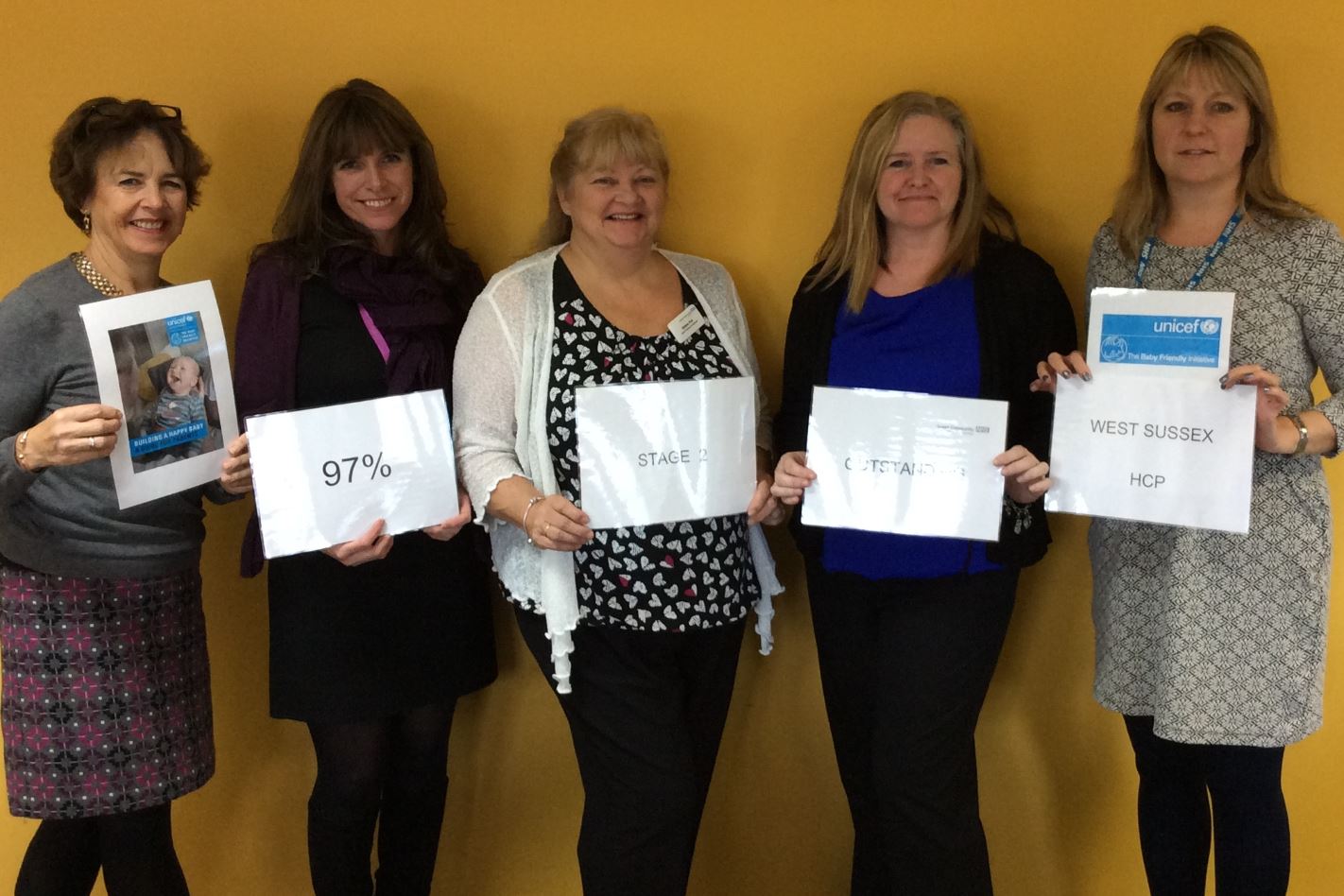
Congratulations to Sussex Community NHS Foundation Trust’s (SCFT) Healthy Child Programme in West Sussex which has received an OUTSTANDING result for Stage 2 Baby Friendly accreditation by UNICEF.

SCFT’s Health Visiting and Infant Feeding Team

SCFT’s Health Visiting and Infant Feeding Team

SCFT’s Health Visiting and Infant Feeding Teams underwent a rigorous assessment process to provide assurance that they deliver the very highest standards of care. SCFT received Stage 1 Baby Friendly accreditation in July 2015 and were “highly commended”.

Stage 2 of the Baby Friendly Initiative assessment assesses the level of knowledge and skills of staff that are providing breastfeeding support and care for pregnant women, mothers and babies.

SCFT is now working towards Stage 3 accreditation. Assessors will interviews mothers across West Sussex to assess if they have been given antenatal and postnatal advice and support by their Health Visiting service as required by UNICEF Baby Friendly. SCFT aims to pass Stage 3 and to be fully accredited as UNICEF Baby Friendly in 2017.

The Department of Health is implementing a new outcome measure of child health at age 2-2½ years, the data for which will be published in the Public Health Outcomes Framework from 2017.

The measure will help monitor child development across England so that we can observe changes in population health from year to year, and potentially also use the data to track children’s outcomes as they grow up. The data will also help to assess the effectiveness and impact of services for 0-2 year olds and support future planning.

Health Visiting providers have been asked to submit data on ASQ-3 scores from October 2015. Department of Health are asking that ASQ:SE data is collected alongside ASQ-3 scores from 1 October 2016.


The National Children’s Bureau (NCB) is pleased to announce the publication of Delivering the Healthy Child Programme for young refugee and migrant children.

The report

This report, based on a scoping study undertaken by NCB, discusses the barriers and enablers refugee and migrant families experience in promoting the health of their young children (from pregnancy to age 5). It explores how local authorities, in shaping their Healthy Child Programme 0-5, are addressing the needs of these young children and their families. The report makes recommendations for how national and local government can promote a healthy start for young refugee and migrant children in England.

This report will be promoted to local public health agencies and voluntary organisations to raise awareness and share examples of practice.

This will be used by our new local authority commissioners. This guidance is for local authorities commissioning ‘public health services for children and young people’ and in particular delivering the Healthy Child Programme 0-5 and 5-19.

The Healthy Child Programme aims to bring together health, education and other main partners to deliver an effective programme for prevention and support.

baby_1422x948