
Further investment from The Royal Foundation Centre for Early Childhood to support health visitors to “give babies a voice” following the publication of the iHV ADBB Phase Two Study.

Today, the iHV, in collaboration with the University of Oxford, published the findings from its latest evaluation of the use of the Alarm Distress Baby Scale (ADBB) in health visiting practice across the UK. We are also delighted to announce that we will be able to continue to support embedding of the tool within health visiting thanks to further investment from The Royal Foundation Centre for Early Childhood.

The tool, known internationally as the Alarm Distress Baby Scale (ADBB), is used by health visitors within routine checks to promote infant wellbeing. It focuses on a baby’s social behaviours such as eye contact, facial expression, vocalisation, and activity levels to help practitioners and families better understand the ways babies express their feelings and to help parents and carers with bonding and attachment. It can also be used to recognise early signs of psychological distress, enabling specialist support to be accessed as soon as it is needed.

Our evaluation found that:

  • ADBB training addresses a clear gap in health visiting practice by strengthening understanding of infant social withdrawal and increasing practitioner confidence in observing and interpreting babies’ behaviour.
  • Health visitors reported feeling better equipped to articulate the baby’s perspective, an area they felt is often less emphasised in other training, which tends to focus more on parental behaviours. This enhanced ability to “give the baby a voice” supported richer, more balanced conversations with parents.
  • There were measurable changes in practice at the 6–8‑week postnatal review. The proportion of babies identified with concerns increased from 7% to 12%. Yet, importantly, referrals to specialist services reduced, suggesting that ADBB supports earlier identification of emerging needs and enables more proportionate responses within universal services.
  • Parents described the 6–8‑week review as reassuring, supportive and confidence‑building. They particularly valued warm, non‑judgemental communication, a clear explanation of their baby’s behaviour and cues, feeling listened to, and emotional support and validation. When introduced clearly, ADBB‑informed observation was experienced as collaborative and empowering.

Eileen Perrins, Perinatal & Infant Mental Health Lead, Institute of Health Visiting, explains more (with thanks to Debbie Barrett & Darren Alderson-Hall – Hampshire & Isle of Wight Healthcare NHS Foundation Trust for co-ordinating, the staff at Bridgemary library for hosting and for all the parents and their wonderful babies for taking part in the filming):

Next steps in this project

The Royal Foundation Centre for Early Childhood has today announced next steps in this project to build upon the positive independent evaluation of the phase two study, with recommendations for ADBB to be commissioned across the country.

Her Royal Highness The Princess of Wales first saw the tool in use when she met health visitors in Denmark in February 2022, and The Centre has been working with the Institute of Health Visiting (iHV) ever since, to bring the benefits of the approach to families in England, Wales, Scotland and Northern Ireland.

Phase one of the study ran in two NHS Trusts from May 2023 – February 2024, exploring the feasibility of implementing a modified version of the tool (m-ADBB) within health visitors’ routine 6-8-week checks with families. It had overwhelmingly positive results.

Phase two of the study, which ran from October 2024 – March 2026, then explored the impact of training health visitors in the ADBB and its modified version (m‑ADBB), across eight sites throughout the UK. This phase set out to assess how training influences practitioners’ knowledge, confidence, and practice; examine changes in identification, referrals and support at the 6–8-week postnatal review; and explore parents’ experiences of the approach.

To support local authorities to take up the use of the tool, The Centre for Early Childhood will fund the iHV to produce a guide to commissioning ADBB, as well as to develop new resources tailored to a UK audience. In line with a key recommendation from the evaluation, The Centre will also fund iHV to create a new ADBB Community of Practice for the next three years, to support practitioners in the continued use and embedding of the tool. This will play a central role in supporting ongoing learning, supervision, and peer support, helping to ensure practitioners are supported to safely and effectively embed the approach in routine care.

Alison Morton OBE, CEO of the Institute of Health Visiting, said:

“The findings reinforce the role of health visitors as highly skilled practitioners, able to build trusted, therapeutic relationships with families and to guide sensitive, open discussions. Getting the right support to families at an early stage can have a hugely positive impact on a baby’s whole life. We want every commissioning body in the UK to consider using this tool so that every family with a newborn can benefit.”

Christian Guy, Executive Director of The Royal Foundation Centre for Early Childhood, said:

“By equipping practitioners and families to understand what babies are communicating from the very start, we can give infants a stronger voice in early conversations, identify where extra support may be needed earlier, and help families build the responsive, nurturing relationships that we know are so important in shaping lifelong outcomes.

“The more health visitors are trained in this use of this tool, the better equipped they will be to help, which is why we are so determined to do everything we can to support its roll out across the UK.”

While the study found the training to be acceptable and impactful, it also makes clear that learning to observe and interpret babies’ behaviour is complex and requires ongoing practice, supervision and support. Successful implementation depends on organisational readiness and system‑level conditions including manageable caseloads, continuity of care, protected time, and clear governance and referral pathways.

ADBB Phase Two Study Report:

Today marks the start of Infant Mental Health Awareness Week (#IMHAW2025). Organisations and services working with families across the UK get a chance to celebrate the vital work they do to support babies’ earliest relationships with their parents and caregivers.

Alison Morton, Chief Executive of the Institute of Health Visiting, said:

“At the iHV, we know how important early relationships are in shaping a baby’s lifelong chances. And we know how important health visitors are in creating a safe psychological space for parents to explore the joys and uncertainties of new parenthood.

“That’s why we are excited to be leading a second phase of research, funded by The Royal Foundation Centre for Early Childhood, around health visitors’ use of the Alarm Distress Baby Scale (ADBB). The expansion of the ADBB, and its modified version, in a wider range of health visiting services will enable us to consider future sustainability of the model and help to direct the right support to the families who most need it.”

Health visitors are being trained in sites across all UK nations to better observe and interpret the ways that babies communicate through their facial expressions, eye contact, sounds and movements. By using the ADBB observation aid, health visitors can help parents discover the amazing social capacities of their babies, the ways babies show that they want to be in a relationship, and the subtle ways they indicate if something in their environment is causing them stress.

In this short film, created by The Royal Foundation Centre for Early Childhood for #IMHAW2025, two of the health visitors participating in the study clearly articulate the importance of early relationships in establishing good mental health. It showcases the knowledge and skill of health visitors to support all families to lay the best foundations for their babies.

Hilda Beauchamp, Perinatal and Infant Mental Health Lead at the Institute of Health Visiting, said:

“I am so proud of the commitment of the health visitors involved in this study. They are achieving very high certification in ADBB, demonstrating robust knowledge and skill in their observation and understanding of babies’ communication and have been excited to use their enhanced skills to support families up and down the UK. This short film showcases the knowledge, skill and passion of health visitors in supporting all families to lay the best foundations for their babies. We know health visitors are amazing – and it’s great to be able to share a glimpse of the amazing work they do!”

The Royal Foundation Centre for Early Childhood has shared a second short film as they caught up with some of the brilliant health visitors who are part of the second phase of the “ADBB” pilot as well as iHV’s Perinatal & Infant Mental Health Lead, Hilda Beauchamp – see video below This is a study of how a simple, yet powerful observation tool, can be used by professionals to spot early signs of emotional distress in babies through their eye contact, expressions, sounds, and activity.

Special thanks to the families, the health visiting services in Rotherham Doncaster and South Humber NHS Foundation Trust and West Street Family Hub, Scunthorpe who contributed to the film.

Thanks to the continued support of The Royal Foundation Centre for Early Childhood, the Institute of Health Visiting (iHV) is delighted to announce the start of Phase Two of the ADBB study. Following the positive results of the first study, which reported an increase in health visitors’ knowledge and skills in interpreting baby behaviour as a result of training in a new observational tool, this second phase seeks to evaluate the impact of the tool in more sites across the UK. The study will be led by the iHV, in partnership with Professor Jane Barlow at the University of Oxford and Dr Alexandra Deprez, Consultant psychologist and ADBB trainer, and will run until March 2026.

The tool, known internationally as the Alarm Distress Baby Scale (ADBB), focuses on a baby’s social behaviours such as eye contact, facial expression, vocalisation, and activity levels to help practitioners and families better understand the ways babies express their feelings. Phase Two of the study will build on the findings from the first study which sought to explore how acceptable and feasible health visitors found using the baby observation tool (the ADBB, and its shorter modified version, the m-ADBB) during their routine 6-8-week visits to families. If you are interested in the findings from the Phase One ADBB Study, please use the link to the pdf here: https://bit.ly/4a7z2hT.

Christian Guy, Executive Director of The Centre for Early Childhood, said:

“We know that warm, loving, responsive interactions with those closest to them during the earliest weeks and months of a baby’s life are crucial in promoting positive brain development.

“Health visitors do such a vital job in our communities.  I am delighted that we are now able to give more teams across the UK the support they need to help thousands of families to better understand their babies and build nurturing relationships, laying the strongest possible foundations for all that is to come in the years that follow.”

The second phase will address a number of recommendations from the first study in the UK context, including:

  • The development and implementation of the expansion of the m-ADBB and ADBB training programme within health visiting teams in a number of different sites across the UK.
  • The evaluation of the impact of the above expansion on practice, outcomes of referrals, and acceptability to parents.

Alison Morton, Chief Executive of the Institute of Health Visiting said:

“We are delighted to have the continued support from The Royal Foundation Centre for Early Childhood to deliver the second phase of this exciting programme of work. As we know, babies can’t talk, but there is significant evidence that their early experiences influence their future outcomes.

“The expansion of the use of the modified ADBB tool in a wider range of health visiting services will allow us to consider its future implementation and sustainability, and ensure more families get the right support and babies can thrive.”

Following significant interest from several potential health visiting services, we are pleased to confirm that the following have been selected for participation in Phase Two:

  • Ayrshire and Arran Health Board, Scotland
  • Cwm Taf Morgannwg Health Board, Wales
  • Hampshire and Isle of Wight Healthcare
  • Humber Teaching NHS Foundation Trust, England
  • Northern Health and Social Care Trust, Northern Ireland
  • Rotherham Doncaster and South Humber NHS Foundation Trust – Doncaster, England
  • Rotherham Doncaster and South Humber NHS Foundation Trust – North Lincs, England
  • South Warwickshire NHS Foundation Trust, England

This grant from The Royal Foundation Centre for Early Childhood will continue to accelerate our work to support health visitors in promoting infant wellbeing and social development, and by enhancing health visitors’ ability to identify infants at risk. We thank The Royal Foundation for their ongoing support.

For more information, please contact [email protected]

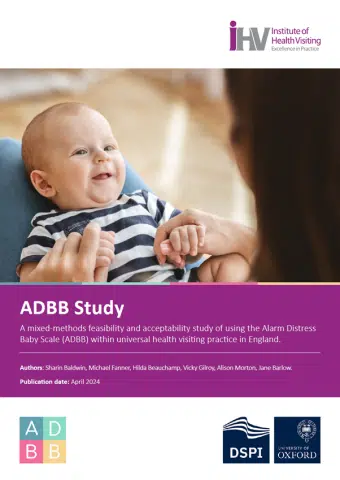
Today, the Institute of Health Visiting (iHV) is delighted to share the overwhelmingly positive findings from their mixed-methods feasibility study into the use of the Alarm Distress Baby Scale (ADBB) in routine health visiting practice in England.

The study, commissioned and funded by The Royal Foundation Centre for Early Childhood, was conducted in partnership with Professor Jane Barlow from the University of Oxford. It sought to explore how acceptable and feasible health visitors found using the baby observation aid, the ADBB, and its shorter modified version, the m-ADBB, during their routine 6-8-week visits to families.

During the ten-month study, health visitors trained in the ADBB and m-ADBB were recruited from South Warwickshire NHS Foundation Trust and Humber Teaching NHS Foundation Trust. Quantitative and qualitative data were collected over a four-month period, during which the trained health visitors used their enhanced skills and knowledge to observe babies’ behaviours and interactions and identify those in need of a more thorough assessment or additional support.

Health visitors described the ADBB approach as “hugely beneficial” and “of great importance” to their practice. Findings demonstrate that both training programmes (ADBB and m-ADBB) were rated highly by all study participants, giving a new theoretical perspective, additional knowledge and skills, and a new vocabulary for explaining their observations of a baby’s behaviour. The use of the shorter validated 5-item version of the scale, the m-ADBB, was found to require minimal additional time and was considered easy to embed into routine health visiting practice (for example, the observation could be undertaken when parents were undressing their baby, or the baby was being weighed). Using the m-ADBB in this way enabled health visitors to:

  • Have more meaningful conversations with parents and carers about the emotional wellbeing of their baby;
  • Promote positive parent-infant interactions, attachment, and bonding; and
  • Identify those babies and families in need of greater support during this critical period of development.

Dr Jane Barlow, Professor of Evidence Based Intervention and Policy Evaluation at The University of Oxford, who oversaw the evaluation of the trial said:

“Babies are born with amazing social abilities. They are ready to relate and engage with the world around them, communicating how they feel through their behaviours.

“Whereas previous approaches have focused on the parents’ perspective, this training has really helped health visitors to ‘read’ the baby during interactions and develop greater sensitivity in terms of the observation of potential attachment and bonding issues that would not have been identified without the training.

“The feedback from those involved has been overwhelmingly positive. It is truly exciting to think about the impact this could have on families right across the country as we enter the next phase of this research.”

Alison Morton, CEO of the Institute of Health Visiting, said:

“Babies can’t talk, but there is now good evidence that they can communicate their experiences of the world around them when we tune in to their behaviours. We are therefore delighted by the positive findings from this study which found that the modified ADBB tool was very workable within universal health visiting practice, providing an important new way for health visitors to observe babies interacting with the people around them. There are many reasons why a baby might be distressed or withdrawn. Spotting these problems as early as possible is important as it will enable health visitors to work with families to ensure that they get the right support and babies can thrive.”

During the study period, health visitors identified behavioural concerns in 23 (10%) of babies as a result of using the m-ADBB. Health visitors were then able to work with families to explore the many possible reasons for this and determine the most appropriate next steps. All identified families were offered additional support, ranging from follow-up visits, emotional wellbeing visits and video interaction guidance (VIG) as well as connections to Child and Family Centres and referrals to Specialist Perinatal Mental Health and other local support services where indicated.

Conclusions and next steps

The quality of interactions that a baby has with their parent or caregiver is associated with their long-term development outcomes. Health visitors have a key opportunity in their routine contacts with families to promote optimal parent-infant interactions and identify emerging concerns. However, assessing these interactions can be quite complex, requiring a robust theoretical understanding as well as sound clinical observational skills.

The ADBB training introduced health visitors to the concept of social withdrawal – a coping mechanism that babies may use if they are experiencing some sort of stress in the environment around them. The additional understanding gained from observing babies’ behaviour from this perspective sat very well alongside health visitors’ existing skills. It helped them to consider how babies let us know they are ‘here, and engaging with the world’ and identify where additional support may be needed.

Executive Director of The Centre for Early Childhood, Christian Guy, said:

“The quality of the relationships between babies and their parents or carers, during the first weeks and months of life, shapes their developing brains and lays the foundations for their future health and wellbeing. So, it is vital that we provide families with the best possible advice and support at this crucial time.

“The results of the initial phase of testing are so encouraging. We now want to move quickly to ensure we build on this work, bringing the benefits of this model to more health visitors across the country so that, ultimately, more babies and their families get the support they need to thrive.”

In light of the positive findings of this study, the report includes recommendations for a second phase of research and evaluation of the tool in the UK context. In addition to several suggested research strands, consideration should also be given to:

  • a UK-based training programme with amendments to the training to align with the UK context, incorporating the training improvement recommendations from this study
  • Evaluation of the impact of training in more health visiting sites across the UK
  • Support systems for health visitors if ADBB/m-ADBB are adopted within health visiting practice, to include continuing professional development, supervision, learning resources and practice opportunities

The iHV, in partnership with the University of Oxford, would like to express its sincere thanks to The Royal Foundation Centre for Early Childhood for funding this important study and for their support and oversight throughout the study period.

Training in the ADBB and m-ADBB was kindly provided by Alexandra Deprez and Jocelyne Guillon of Humagogie training centre. Further details can be found at adbb-scale.com.

To cite this report , please use the link to the pdf here: https://bit.ly/4a7z2hT

The research team would like to acknowledge the governance and guidance of the Expert Advisory Group:

  • Alison Morton (Chair) – Institute of Health Visiting
  • Dr. Sarah McMullen – The Royal Foundation Centre for Early Childhood
  • Hannah Sereni – Start for Life Unit
  • Wook Hamilton – Parent-Infant Foundation
  • Professor Crispin Day – South London and Maudsley NHS Foundation Trust
  • Lynne Reed and Wendy Nicholson – Office for Health Improvement and Disparities
  • Sarah Muckle – City of Bradford Metropolitan District Council, Director of Public Health
  • Professor Carl May – London School of Hygiene & Tropical Medicine

And the dedicated health visitors, managers and research departments at the Humber Teaching NHS  Foundation Trust and South Warwickshire University NHS Foundation Trust who participated in the study.


Watch Sky News article: ‘Overwhelmingly’ positive results for trial funded by Princess of Wales as part of early years work