Were you inspired by our speakers at our iHV EBP 2025 conference? Next year it could be you!

Our call for iHV Evidence-based Practice (EBP) Conference 2026 abstracts is now open!
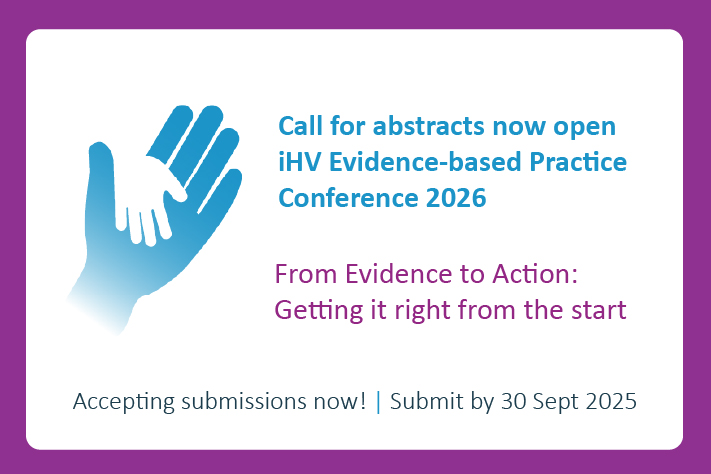
Submit your abstract for our iHV Evidence-based Practice 2026 conference “From Evidence to Action: Getting it right from the start” which will be held at Bournemouth International Conference Centre on 6 May 2026.

Babies’ and children’s health and wellbeing have seen a concerning decline in recent years, with children in the UK having some of the worst health outcomes compared to other similar nations. Health inequalities are widening, especially for those living in more deprived neighbourhoods where the poorest babies and children have the worst outcomes.

Early childhood is important as it lays the foundation for lifelong health and, without meaningful intervention now, we are on course for a generation of adults facing serious health challenges. Improving our babies’ and children’s health will take comprehensive effort across all of society.

Innovation, research and new ideas will be critical to driving the change that is needed. And we know that health visiting teams and researchers across the UK are leading the way with so much great work taking place to improve outcomes for babies, children and families.

Join us to celebrate and spread excellence in practice:

  • Help share your learning with others facing similar challenges
  • Maximise the impact of your work on a bigger scale
  • Submit an abstract to present at our EBP conference in 2026

Connect with other local, national, and international experts, who will be sharing their latest developments in practice, innovation, and research to improve the health and wellbeing of babies, children, families and communities.

What are the benefits of presenting at the iHV conference?

It’s an excellent opportunity for you to:

  • Raise your own profile as a speaker at a UK-wide conference
  • Raise the profile of your organisation and showcase your work
  • Connect, collaborate and learn from other practitioners working in the field of health visiting and family public health
  • Add your experience of presenting to your CV and boost your career

What are the presentation opportunities for accepted abstracts?

  • A plenary keynote presentation – oral presentation in the main hall (and live-streamed to online delegates), followed by involvement in Q&A panel.
  • An oral concurrent presentation – oral presentation in one of our concurrent streams, followed by involvement in Q&A panel (note: selected concurrent sessions in the main hall will be live-streamed).
  • A breakout oral presentation (a 4-minute speed talk) – strictly time-limited presentation delivered in one of our breakout sessions – provides an opportunity to extend the reach of your work, but in a concise form (note: selected breakout oral presentation session in the main hall will be live-streamed).
  • A poster presentation (for display in the exhibition hall) – posters are a visual display of material and are particularly suited to the presentation of data, project design and findings. Presenters are on hand to facilitate discussion with delegates during the break times.

Abstract timeline:

  • Submissions: The abstract submission deadline is 30 September 2025
  • Notifications: After an iHV peer-review process, participants will be informed of the outcome by email on 17 October 2025 – this will include details of the type of presentation that you have been selected for.

Further details on our conference topics and how to submit an abstract can be found here.

We look forward to reading your abstracts and hearing about your practice innovations and research! Any questions – please email [email protected].

Yesterday, the Scottish Government launched their Infant Best Practice Guidelines which includes a national ‘Infant pledge’.

Hilda Beauchamp, iHV Perinatal and Infant Mental Health Lead, welcomed this important policy commitment to infants stating:

The iHV is delighted to support the launch of the Scottish Government’s Voice of the Infant best practice guidelines and infant pledge. Co-produced as part of the Perinatal and Infant Mental Health Programme board, the new Scottish Model of Infant Participation places babies and very young children ‘front and centre’ to ensure that they are always in focus and their views are shared and acted on.

“The Model is depicted in the colours of the Scottish landscape, representing heather, forest, hills and sea but, more importantly, drawing the attention to four key domains for all who care for and work with infants. These are Space and Voice, relating to the infant’s right to express their views, Audience and Influence, relating to their right to have their views given due weight.

“These important documents add weight to the already very enabling policy context for infants in Scotland, building on the Getting It Right for Every Child (GIRFEC) approach, the UNCRC (Incorporation)(Scotland) Bill, The Promise, Child Poverty Delivery Plans and Covid Recovery Strategy, and will contribute to the national ambition for every baby, child and young person to be loved, safe, respected and realise their full potential.”

There has been a well-documented and persistent ‘Baby Blindspot’ in national policy. This pledge represents an important step in fully recognising the needs of our youngest citizens in Scotland. We join with others in calling for similar initiatives in all UK nations.

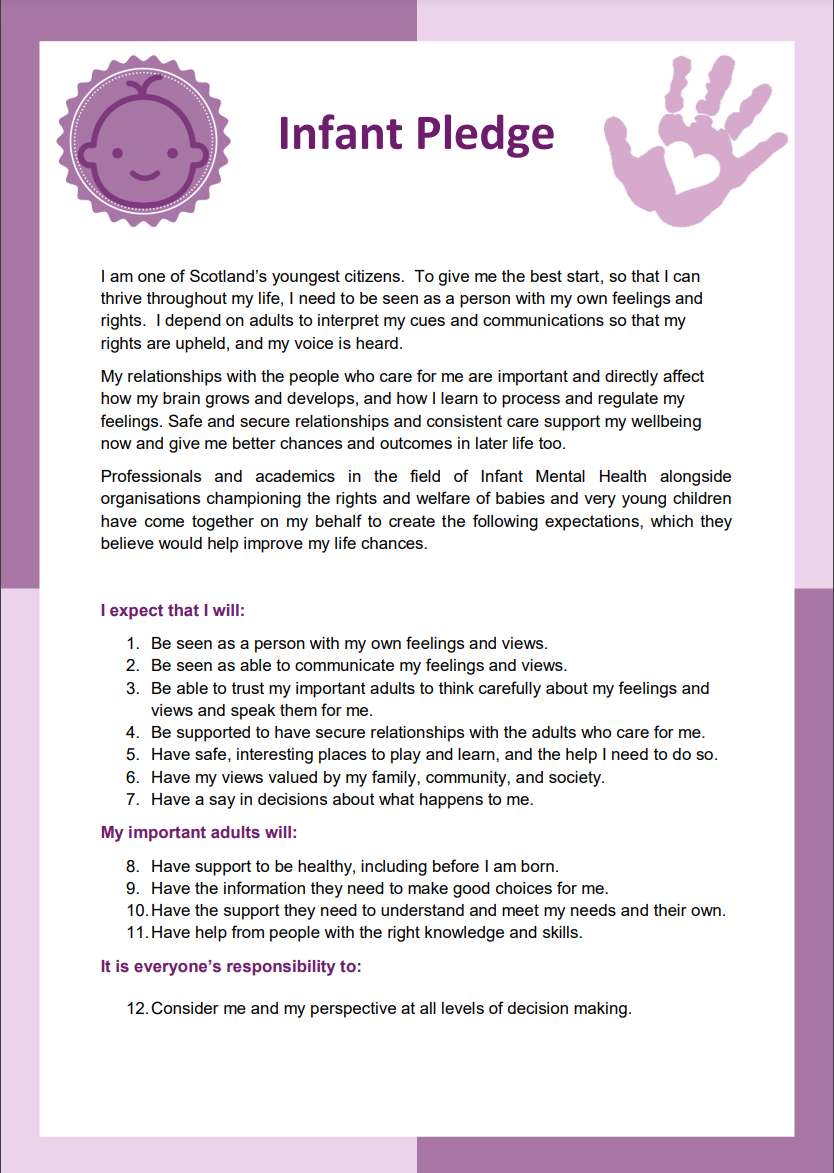
The Pledge is written in simple language and from the baby’s perspective. It is available as a one page sheet that can be printed and put up as a poster in places welcoming babies.

Infant Pledge

I am one of Scotland’s youngest citizens. To give me the best start, so that I can thrive throughout my life, I need to be seen as a person with my own feelings and rights. I depend on adults to interpret my cues and communications so that my rights are upheld, and my voice is heard.

My relationships with the people who care for me are important and directly affect how my brain grows and develops, and how I learn to process and regulate my feelings. Safe and secure relationships and consistent care support my wellbeing now and give me better chances and outcomes in later life too.

Professionals and academics in the field of Infant Mental Health alongside organisations championing the rights and welfare of babies and very young children have come together on my behalf to create the following expectations, which they believe would help improve my life chances.

I expect that I will:

  1. Be seen as a person with my own feelings and views.
  2. Be seen as able to communicate my feelings and views.
  3. Be able to trust my important adults to think carefully about my feelings and views and speak them for me.
  4. Be supported to have secure relationships with the adults who care for me.
  5. Have safe, interesting places to play and learn, and the help I need to do so.
  6. Have my views valued by my family, community, and society.
  7. Have a say in decisions about what happens to me.

My important adults will:

  1. Have support to be healthy, including before I am born.
  2. Have the information they need to make good choices for me.
  3. Have the support they need to understand and meet my needs and their own.
  4. Have help from people with the right knowledge and skills.

It is everyone’s responsibility to:

  1. Consider me and my perspective at all levels of decision making.