7th November 2025
Families seeking refuge and asylum in the UK hold a wealth of parenting practices that can help their children thrive, even in challenging circumstances. These are practices that health visitors can recognise and help support, given the right skills, tools, and opportunities.
Professors Monica Lakhanpaul, Professor of Integrated Community Child Health at UCL Great Ormond Street Institute of Child Health, University College London , and Nadia Svirydzenka, Professor of Cultural Identities at De Montfort University, Leicester, are partnering with iHV on an NIHR-funded project to gather insights into opportunities that exist in health visiting for offering such culturally-responsive support for some of the most vulnerable families. Here, they outline the potential for tailored support, and how you can help build the evidence base.
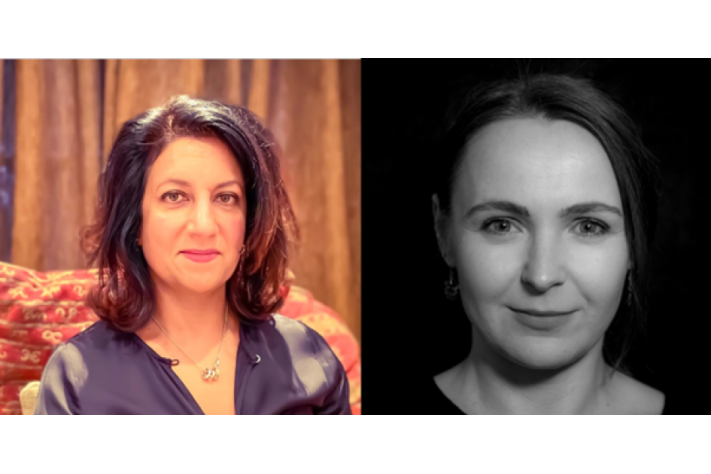
From left: Professor Monica Lakhanpaul (Professor of Integrated Community Child Health at UCL Great Ormond Street Institute of Child Health, University College London, and Professor Nadia Svirydzenka (Professor of Cultural Identities at De Montfort University, Leicester)
The challenge for parenting and support in resource-limited settings
Many refugee and asylum-seeking families are housed in unsuitable accommodation in the UK – often for extremely prolonged periods (going far beyond temporary).
The complex housing, social, and cultural circumstances that refugee and asylum-seeking families find themselves in can often severely impair parents’ ability to support their children’s health, development and education, through no fault of their own.
In turn, it means that parental support provided by health visitors needs specific tailoring to account for these intersecting challenges.
That’s because temporary accommodation means families are living in small, crowded living spaces that impact children’s movement and play.
Often, parents have little or no access to cooking facilities, let alone culturally-familiar foods and ingredients, which makes cooking nutritious meals for the little ones almost impossible.
Such families also find themselves in an unfamiliar culture and having to learn new ways of doing things (and unlearn practices that make them ‘different’), while also navigating new and complex systems to get the support they need. Often parents have had traumatic experiences in their country of origin and while travelling in search of safety, that render certain topics painful and leave families open and vulnerable to stress.
All of this takes its toll.
For young children, such circumstances can severely impact their development, leading to poor health and wellbeing outcomes that can persist throughout a lifetime.
Parents of these children need additional support to feel capable and confident to raise their children to thrive in the UK without losing ties to who they are, even in these difficult circumstances.
Health visitors are well positioned to provide such support, and we are seeking to understand how.
An opportunity to deliver tailored support
Our research collaboration – between UCL (University College London), De Montfort University, Institute of Health Visiting, Flinders University, Queen Mary University London, CFI, topic and lived experience experts, and community-based charity Happy Baby Community – is working directly with refugee and asylum-seeking parents to understand how they can be better supported while living in such settings.
Through a mixture of interviews, workshops, and storytelling activities with refugee and asylum-seeking families living in temporary accommodation, we will explore creative and adaptive ways of parenting that stay true to their heritage by bridging their cultural assets with resource-limited settings where they live. In particular, we are seeking to understand how parents might draw on their own heritage and assets to help their children flourish.
How you can help:
To supplement family voices, we are also keen to hear a health visitor perspective. Through your experiences and insights, we can understand how you are already supporting this population, and what further support you need to offer more tailored guidance.
Gathered insights from families and health visitors will inform the co-designing of a culturally responsive parental support programme that is tailored to meet the specific needs of these families, and that draws on the strengths they already hold.
Our hope is that our project will have implications beyond this community, offering a model for asset-based and culturally-informed support for all parents.
You can be a part of making that happen.
Tell us your views and experiences by completing our survey
We need your views and experience of working with refugee and asylum-seeking families – even if you do not directly work with refugee and asylum-seeking families, we would like your views:
- For those people on our mailing lists (including members, previous members and Champions), you will have received an email from us with the survey link. So please do check your emails.
- For those health visitors or health visiting team members who are not on our mailing lists and would like to complete this survey, please contact [email protected] to request the survey link.
All responses are anonymous and stored securely in line with GDPR.
Thank for taking the time to contribute to this important work.
Professor Monica Lakhanpaul, Professor of Integrated Community Child Health at UCL Great Ormond Street Institute of Child Health, University College London, and Professor Nadia Svirydzenka, Professor of Cultural Identities at De Montfort University, Leicester

This study/project is funded by the National Institute for Health and Care Research (NIHR) Programme Development Grant NIHR298364. The views expressed are those of the author(s) and not necessarily those of the NIHR or the Department of Health and Social Care.


