
24th September 2026
In Black Maternal Mental Health (BMMH) Week 2026, read this Voices blog by Emily Miller, iHV Professional Development Officer in Perinatal & Infant Mental Health, who shares latest updates from some of this week’s events.

Emily Miller, iHV Professional Development Officer in Perinatal & Infant Mental Health
This week has been a busy week in Parliament with a number of events focused on Black women’s health, including The Motherhood Group’s Parliamentary Breakfast, and Five X More’s All-Party Parliamentary Group (APPG) on Black Maternal Health on Tuesday 22 September. These are just two events which form part of a jam-packed Black Maternal Mental Health (BMMH) Week 2026, and I had the honour of attending the Five X More APPG with Alison Morton OBE, our CEO!
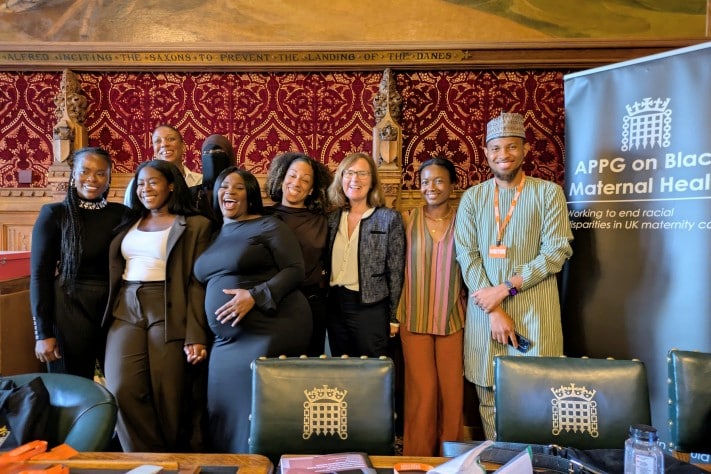
Five X More’s All-Party Parliamentary Group (APPG) on Black Maternal Health on Tuesday 22 September 2026
The theme of BMMH Week 2026 is “Joy, Justice, and Journey,” and I can’t tell you how energised I felt just by being in a room full of so many inspiring women, who are all lobbying tirelessly for much-needed change.
MBRRACE-UK 2026
The need for change could not be clearer. The latest MBRRACE-UK report¹ shows that:
- Since 2010, maternal death rates have increased by 20% (despite the previous government’s pledge to half the death rate at the time)
- Racial inequalities persist – during pregnancy or up to six weeks after birth, Black women were nearly three times more likely to die compared with white women
- Maternal suicide remains the leading cause of direct deaths between six weeks and one year after birth
- Overall, mental health conditions (including suicide and substance use) accounted for a third of maternal deaths in this late postnatal period
- Nearly half of the women and birthing people who died in pregnancy up to six weeks after birth had known mental health problems – 10% higher than in 2019–21.
“Racially driven inequalities are unjust and not inevitable – and tackling this must be a public health priority.”
Alison Morton OBE, CEO, Institute of Health Visiting.
It is clear that persistent inequalities in healthcare access, experience and outcomes continue to disproportionately affect Black women. And for mothers facing intersecting or multiple disadvantages, barriers to care are heightened.
Five X More: amplifying the voices of Black women
“Black women are not reluctant to talk about what they are going through. They just need a safe space to do it.”
Five X More report²
At the APPPG, Five X More launched the latest findings in its report, Understanding Black Maternal Mental Health in the UK². Drawing on the lived experiences of Black women who took part in its latest survey of Black maternity experiences (n=845), this report explores the mental health experiences and thoughts of Black mothers who reported experiencing a mental health problem during and after pregnancy (62%; n=527). The findings are clear: Black women are still facing barriers of racism, systemic biases, and structural inequalities – collectively, the system must do better.
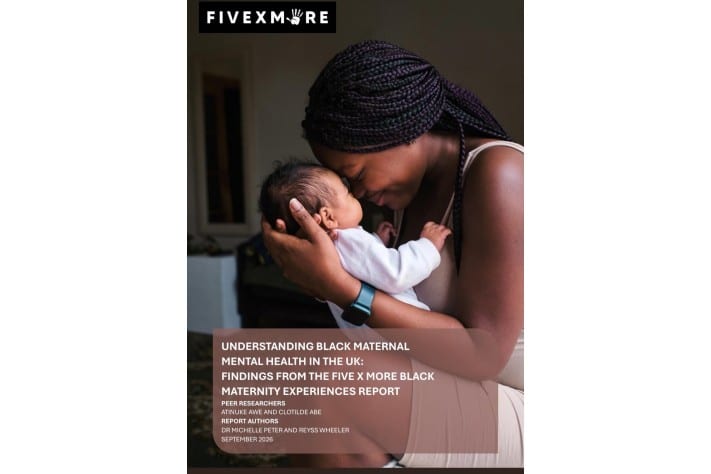
Key findings:
- 62% of women reported experiencing a mental health problem before, during or after pregnancy
- Of these women, 66% experienced mental health difficulties during pregnancy and 71% during the postnatal period
- However, 61% were not referred or signposted to mental health support
- 56% were not told how to access emergency mental health services
- And only 34% described their overall mental health support experience as good.
Health visitors: vital pillars of the perinatal network
“Human interaction is where healing starts – and we need to get it right.”
Christina Brown
Health visitors are vital pillars of the perinatal and infant mental health network, and a strong and trusting therapeutic relationship has the greatest impact on outcomes for people with mental health difficulties – over and above the specific intervention provided3.
We need to make space to build strong, trusting therapeutic relationships and create safe psychological spaces where Black women feel able to disclose what they are experiencing. We need to make sure we are listening, responding and connecting women with services where they feel represented, offering interventions which are culturally relevant.
There is so much more we can do to ensure that every woman feels heard, believed and supported.
As the Maternal Mental Health Alliance⁴ reminds us:
“Safe perinatal mental healthcare depends not only on crisis response, but on sufficiently staffed, universal services that can identify vulnerability and risk early, provide continuity, and ensure that mothers and birthing people feel seen, heard, and supported before difficulties reach crisis point.”
Our professional responsibility
Creating safe spaces for disclosure is not just good practice; it is part of our professional duty. The NMC Code⁵ asks us to treat people as individuals and uphold their dignity. It also asks us to make sure that those receiving care are treated with respect, that their rights are upheld, and that any discriminatory attitudes and behaviours are challenged. When 61% of the women in the Five X More survey were not referred or signposted to mental health support, we have to ask ourselves honestly whether every woman, and therefore every baby, is receiving that respect and equity of care. The current NMC Code consultation⁶ goes further, proposing clear expectations of anti-discriminatory professional behaviours and actions to promote inclusive practice.
NICE is equally clear about what this means in perinatal and infant mental health practice. Quality Standard 115, Statement 5⁷ states that healthcare professionals should understand variations in the presentation of mental health problems and be sensitive to any concerns women may have about disclosing them. They should also be culturally competent in their discussions with women from Black, Asian and minority ethnic groups, to support full and meaningful discussion. This takes us back to the Five X More finding: Black women are not reluctant to talk. It is our responsibility to make sure that when they do, they are met by professionals who listen, understand and have the skills to respond.
Every contact a health visitor has with a family is an opportunity to be that safe space, so that every woman facing perinatal mental health problems can be connected to the right care for her and her baby.
Huge thanks to Five X More, Clotilde Abe, Tinuke Awe, Bell Ribeiro-Addy MP, Christina Brown, Dr Yusuf Shittu and all the women whose voices were amplified on the day.
For more information on ways to improve health visiting practice:
- Watch our recent iHV Insights webinar ‘Lessons we can’t ignore: Translating evidence on Black maternal health into health visiting practice’ – available here.
- For training (for individual practitioners, or whole organisations): learn more about iHV’s new co-produced Promoting Care Across Cultures Ambassador Training Programme – see our news story here.
Emily Miller, iHV Professional Development Officer in Perinatal & Infant Mental Health
References:
- MBRRACE 2026: Saving Lives, Improving Mothers’ Care 2026 – Lessons learned to inform maternity care from the UK and Ireland Confidential Enquiries into Maternal Deaths and Morbidity 2022-24
Available at https://www.npeu.ox.ac.uk/mbrrace-uk/reports/maternal-reports/maternal-report-2022-2024 (accessed 18.09.26) - Five X More (2026): Understanding Black Maternal Mental Health in the UK.
https://fivexmore.org/black-maternal-mental-health-experiences-2026 - Hartley S, Raphael J, Lovell K, Berry K (2020) Effective nurse–patient relationships in mental health care: a systematic review of interventions to improve the therapeutic alliance. International Journal of Nursing Studies 102: 103490. https://doi.org/10.1016/j.ijnurstu.2019.103490
- Maternal Mental Health Alliance. MBRRACE 2026: Maternal mortality rising in the UK Available at https://maternalmentalhealthalliance.org/news/mbrrace-2026-maternal-mortality-rising-uk/ (Accessed 18.09.26)
- Nursing and Midwifery Council (2018) The Code: Professional standards of practice and behaviour for nurses, midwives and nursing associates.
- Nursing and Midwifery Council (2026) Code consultation.
- NICE (2016) Antenatal and postnatal mental health. Quality standard [QS115] Quality Statement 5: Comprehensive mental health assessment


