4th September 2026
The Birmingham Pathway – health visitors pilot a genomics pathway for babies participating in the Generation Study
Read this Voices blog by Sally Shillaker, iHV Professional Lead (Innovation and Research), showcasing a pathway of care currently being piloted in Birmingham to support practitioners working with families participating in the Generation Study. The pathway provides clear guidance for practitioners to identify participating families and outlines the steps to follow when a baby receives a suspected condition result, including the confirmatory process to establish whether the baby has the condition. A valuable example of how health visiting teams can support families and help navigate emerging genomic pathways in practice.
The Generation Study
The Generation Study opened in 2024 and, as of August 2026, has recruited more than 85,000 babies in England, to screen them for 200+ rare genetic conditions using whole genome sequencing.
Whilst most participants will receive a ‘No Condition Suspected Result’, more than 200 babies so far have received a ‘Condition Suspected Result’ and require confirmatory diagnostic testing.
Where a rare genetic condition is confirmed, care or treatment can be started early, and this will hopefully improve outcomes for the baby. Many of the conditions tested for are not currently screened for on the Newborn bloodspot screening programme. For example, a recent participant was found to have the gene change for a condition called adrenoleukodystrophy (ALD), which is not routinely screened for.
Due to the Generation Study being a research study, parents of any baby who participates are encouraged to also ensure their baby still takes part in all the NHS newborn screening programmes.
For a full list of conditions which the Generation Study tests each baby for, please visit Conditions | Genomics England.
Hearing the health visiting voice to shape best practice for babies, children, and families
To raise awareness and support best practice, the iHV created a short awareness session about the Generation Study and held several forums (in collaboration with colleagues working in the field of genomics). The forums sought to deepen understanding and application in practice. At these sessions, feedback from health visitors was consistent; they told us that they would like to know about any baby who has a condition suspected to optimise their support for the baby and family.
A group of health visiting leaders across England collaborated with colleagues in the Central and South Genomic Medicine Service to develop a simple pathway of care which initially guides practitioners to identify families participating in the Generation Study. The pathway then guides practitioners through the steps required where a baby has a condition suspected result and the confirmatory process to confirm whether the baby has the condition or not.
We have called this the Birmingham Pathway due to the pathway being piloted in Birmingham.
The Birmingham Pathway
Practitioners in Birmingham health visiting teams identify Generation Study families by asking them about whether they are participating in the study at all Antenatal and New Birth Visits – participation is then recorded in their clinical records.
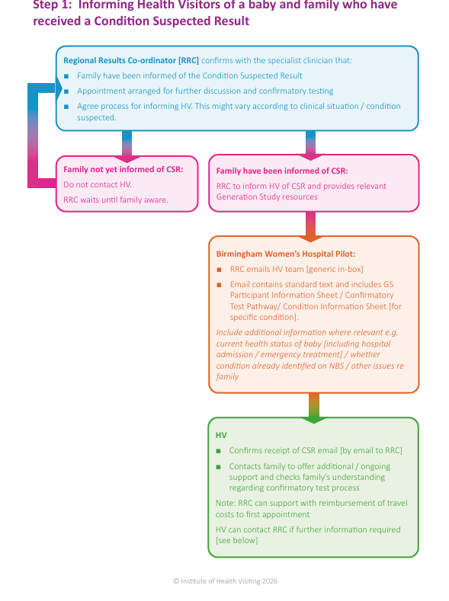
For any baby who has a condition suspected, Birmingham’s Health Visiting team is notified by email from the Regional Results Coordinator (RRC). The named health visitor for the baby and family is then made aware, and they are required to acknowledge the information received and support the family accordingly. Once further tests or investigations confirm whether the baby has the condition suspected or not, the named health visitor is then notified by email from the RRC. The RRC is also available to assist health visiting staff with questions as required.
The diagram below illustrates the Birmingham Pathway for a baby with a condition suspected.
In partnership with Genomics England, the Central and South Genomic Medicine Service, the participating hospitals in Birmingham, and Birmingham Community NHS Foundation Trust, the iHV is delighted to announce that the Birmingham Pathway is open and being implemented for all babies, children and families who are participating.
Health visiting staff in Birmingham have attended bespoke training, are enquiring about participation at all early core visits, and are being informed of results for babies via the RRC, once the family has been informed of their result from a hospital specialist.
Andrew Solomon (Service Clinical Lead, Birmingham Forward Steps, Children and Families Division, Birmingham Community Healthcare NHS Foundation Trust) says:

Andrew Solomon – Service Clinical Lead, Birmingham Forward Steps Children and Families Division, Birmingham Community Healthcare NHS Foundation Trust
“The Birmingham Pathway represents an important step forward in integrating genomics into universal child health services. By ensuring health visitors are informed when a baby receives a ‘Condition Suspected’ result through the Generation Study, we can provide timely, compassionate support to families during what can be an uncertain and emotional time. This collaborative approach strengthens the connection between specialist genomic services and community health teams, helping families feel supported, informed, and connected to the right care from the earliest opportunity.”
Dawn Wickers (Health Visitor, Pathfinder Pilot Immunisation Lead, Rotherham Children’s Public Health Nursing Service) says:
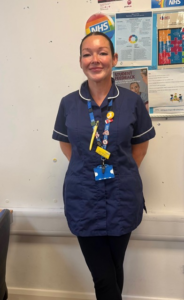
Dawn Wickers – Health Visitor, Pathfinder Pilot Immunisation Lead, Rotherham Children’s Public Health Nursing Service
“It has been a pleasure to support the Generation Study in shaping their HV pathway following my experience supporting a family though their child’s diagnosis.”
Rachel Puddephatt (Regional Results Coordinator for The Generation Study) says:

Rachel Puddephatt – Regional Results Coordinator for The Generation Study
“Although participants of the Generation Study are contacted by me after they have been informed of a genetic difference in their baby, I find it comforting to know that the health visitor providing ongoing care for the family in the future will be involved, so that parents feel supported in their onward care journey.”
Karen Creed (Lead Midwife – Genomics Central and South Genomic Medicine Service) says:

Karen Creed – Lead Midwife – Genomics Central and South Genomic Medicine Service
“Receiving a ‘Condition Suspected’ result often brings uncertainty and anxiety for families. We hope that the Birmingham Pathway will help to strengthen support during this crucial time by ensuring health visitors are involved early, helping families feel informed, supported, and connected to the right services.”
Amanda Pichini (Clinical Director at Genomics England) says:
“One of the most valuable things about the study has been bringing health professionals together across different parts of the health and care system, around a shared goal to improve care for babies and families.
“This Birmingham Pathway is an excellent example of that collaboration, and highlights the importance of health visitors, who bring a unique understanding of the families and communities they support.
“We are extremely grateful to the health visitors and other healthcare professionals who have shaped this approach and look forward to learning from their experience and how it can help improve coordinated care in the future.”
What next for the The Birmingham Pathway?
The Birmingham Pathway is due to be open for 3 months and we are keen to hear from staff and families about how it is working in practice to understand its impact. We will be sharing these findings with Genomics England. This will be useful for the wider evaluation of the Generation Study.
We have developed an infographic about the Generation Study for all health visiting team members with feedback from several health visiting teams in the East of England and the East GMS.
Please scan the QR code below for your copy and note that this is not for patient use.

Or download here.


