
5th June 2026
The Institute of Health Visiting (iHV) welcomes the launch of the new Early Years Kickstarter project – launched today by the Department for Science, Innovation and Technology – which aims to explore how improved data sharing can help ensure children are ready for school.
Alison Morton OBE, iHV CEO, and Professor Lucille Poston, Professor of maternal and fetal health at King’s College London, were invited to represent health visiting at a ministerial roundtable convened by The Rt Hon Ian Murray MP, Minister of State (Minister for Digital Government and Data), to launch the project yesterday.
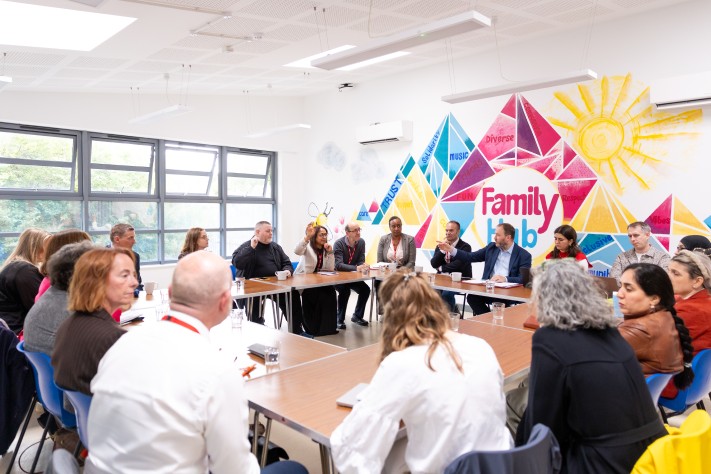
Minister Ian Murray visits a Family Hub in Fulham for the roundtable
The roundtable, held at the Tudor Rose Family Hub in Fulham, brought together representatives from across the early years, health visiting, academics, children’s services and local parents to explore the ways in which better use of data could potentially improve services for parents and children.
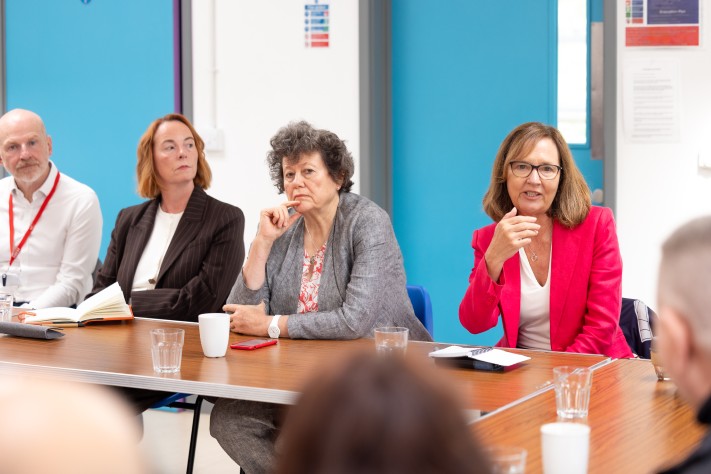
Alison Morton OBE at yesterday’s roundtable event

Minister Ian Murray visits a Family Hub in Fulham
The project will explore options for safely connecting data from health visiting, education and childcare providers – helping to join up services and improve outcomes for children, particularly those facing disadvantage.
There is a clear need for change. Currently, nearly a third of children (32%) start school without the basic skills they need to thrive, rising to almost half (48%) among children eligible for free school meals. This has a significant impact on their educational outcomes and future opportunities. Whilst early intervention can make a big difference, in many areas services can operate in isolation with separate digital systems that aren’t connected and paper-based processes, meaning support is less well-coordinated and risks children falling through the gaps between services.
Starting with Leeds City Council, the London Borough of Hammersmith & Fulham, and councils within the Liverpool City Region Combined Authority, the project will explore how better-connected services can improve coordination and provide more effective support for young children and their families.
Alison Morton said:
“Too often, opportunities to support children early are missed because information is held in separate systems. Improving the way data is shared across public services – including improved data quality, interoperability and analytical capability – is long overdue.
At the roundtable, we spoke about the importance of ensuring that advances in digital technologies are shaped around the needs of babies, children and families and the frontline practitioners who will be using these systems – an ambition that is at the heart of this project. We are delighted to be able to support the Kickstarter project. There is so much potential to make better use of data to help practitioners see the full picture, enabling families to access the right support sooner and ensuring children receive the help they need to thrive.”
Technology Secretary, Liz Kendall, said:
“Too many children are arriving at school without the skills they need, and too many parents have had to fight through a complex, disconnected system to get their child the support they deserve. That burden falls hardest on disadvantaged children.
“We are determined to change old fashioned public services where assessments are recorded by paper and children’s needs are missed.
“Parents, carers and children deserve better and our hard-working early years and healthcare professionals deserve the tools they need to do their jobs – not blockers. The more connected we make our services, the greater the difference we can make for children and families.”
Have your say – take part in the project:
The Department of Science, Innovation & Technology (DSIT) invites parents, health visitors, educational professionals, data professionals and Local Authorities to share their experiences with health and education data for children aged 0-5 years. Your insights will help the project team understand pain points, successes, and areas for improvement to better support early identification of child needs.
If you would like to participate and share your views, please sign up via the form here.


