Executive Summary - Key Messages:
- Every child deserves the opportunity to thrive. Yet, families raising children with special educational needs and disabilities (SEND) are being let down by mounting pressures across health, education, and local authority services, and a well-evidenced postcode lottery of support, causing what is now recognised as a national SEND crisis1.
- Solving the current SEND crisis needs to start long before children start school2. The earliest years of life represent an important window to shape a child’s physical, emotional, and cognitive development. Exposure to adverse environmental factors in the earliest years can have lasting effects on a child's health, development and future outcomes. Life chances are also strongly influenced by social determinants such as family circumstances, poverty, community support and access to services, highlighting the importance of providing strong support early in life.
- Current SEND policy and provision remain largely orientated towards school-age children. As a result, many babies and young children with emerging SEND are not identified early enough to receive the support they need at a time when intervention can make the greatest difference. Lengthy waits for assessment and support contribute to avoidable inequalities in children's development, wellbeing, educational outcomes and future life chances3.
- Improving outcomes for children with SEND requires a whole-child, whole-family and whole-system approach. Costs of late intervention are spiralling out of control, when the evidence is clear that prioritising spending on prevention and early intervention in the earliest years has been shown to yield the greatest return on investment in the medium to longer term4.
- When adequately resourced, health visitors provide an important part of the solution in ensuring that families with SEND are identified and get good, joined-up support. By identifying problems early and intervening before needs escalate, there is also a significant body of evidence which shows that health visitors help reduce pressure on overstretched NHS and public services by enabling earlier intervention and more appropriate referrals, improving outcomes for babies, children and families across a breadth of public health, education and social care priorities5.
- Through their proactive universal reach, trusted relationships with families, home-visiting model and specialist public health expertise, health visitors provide a critical safety-net for every child from pregnancy to school entry. Their proactive contact with all families is particularly important for babies and young children who cannot advocate for themselves, and for those who may otherwise be invisible to services. Health visitors play a vital role in prevention, early identification, care coordination and connecting families to the support they need6. As UNICEF UK describes, they are the “backbone of the early years … the safety-net around all families”7.
- However, the contribution of health visiting to SEND provision is being undermined by significant workforce shortages, inconsistent commissioning, variation in local provision and insufficient investment in prevention and early intervention8,9.
We welcome the Government's response to the SEND crisis and have adapted its reform principles10 to strengthen support for babies, young children and families, and the health visiting services that play a vital role in improving outcomes from the earliest years.
Reform Principles:
- Early: Giving babies and young children equal priority within SEND policy and reform, with a focus on prevention, early identification and early intervention in the earliest years to improve outcomes and reduce future demand on specialist services.
- National consistency, local empowerment: National standards, accountability and integrated commissioning frameworks should set out the support and provision ordinarily available to all babies, young children and families with SEND, reducing unwarranted variation and improving outcomes. Within this framework, local flexibility should enable integrated services that respond to local need while promoting earlier intervention, coordinated support and equitable outcomes.
- Fair: Urgent investment across the whole SEND system is needed to meet rising need, deliver national standards and reduce inequalities. This must include ring-fenced funding for health visiting and a workforce plan to ensure all families can access this vital universal service and core component of early SEND identification and support.
- Effective: SEND support should be evidence based and focused on improving outcomes, taking a whole-family approach that supports parents and carers alongside children from pregnancy onwards. This requires a skilled, confident and sustainable workforce with the knowledge, training and capacity to identify needs early and provide timely, effective support.
- Shared responsibility: Integrated care pathways centred on babies, children and families, bringing together health, education, and community services with shared accountability for outcomes, and health visiting playing a key role in early identification, coordinated support and improved outcomes for children with SEND and their families.
iHV Policy Priorities for Health Visiting
The Institute of Health Visiting recognises that addressing the SEND crisis requires action across the whole system. As part of this wider programme of reform, the iHV calls for a renewed commitment to strengthening the contribution of health visiting to early years SEND provision through:
- Rebuilding the health visiting workforce through a fully funded workforce strategy that restores capacity, reduces unwarranted variation and ensures every family has access to a universal health visiting service, with additional targeted and specialist SEND support proportionate to need.
- Delivering universal access to the Healthy Child Programme, ensuring all children receive the full programme of health visiting reviews to support prevention, developmental surveillance, early identification and timely intervention.
- Strengthening developmental assessment and early identification, through evidence-based approaches that combine professional judgement, holistic assessment, face-to-face contact and home visiting alongside the appropriate use of assessment tools.
- Expanding the universal and targeted health visiting pathway, including enhanced support for children at increased risk of SEND and an additional universal review at around 3½ years to support school readiness, transition planning and earlier access to support.
- Developing a SEND-confident health visiting workforce, supported by ongoing education, supervision, professional development and specialist health visitor SEND leadership to strengthen capability across universal, targeted and specialist services, and to sustain relationship-based care for children and families.
- Embedding health visiting within integrated Family Hub and Neighbourhood Health models, with clear pathways across health, education, social care and community services, and shared accountability for outcomes.
- Providing stronger national leadership, accountability and investment for early years SEND, including a National Early Years SEND Framework, integrated commissioning, improved data systems and sustainable funding for prevention, early intervention and health visiting.
Why the Early Years Matter
The earliest years represent the most important period of child development. Experiences before birth and during the first years of life shape lifelong health, development, educational achievement, and wellbeing...
The earliest years represent the most important period of child development. Experiences before birth and during the first years of life shape lifelong health, development, educational achievement, and wellbeing.
Early identification and intervention are therefore critical during this period of rapid growth, development and heightened neuroplasticity, creating a unique opportunity to influence developmental trajectories and maximise the impact of support and treatment. Evidence shows that prevention and early intervention in pregnancy, infancy and early childhood deliver the greatest return on investment, improving outcomes, reducing inequalities and helping children to reach their full potential.
Despite this, babies and young children remain largely overlooked in SEND policy. This "baby blind spot" means that many children do not receive support until difficulties become more significant and more costly to address.
Children's outcomes cannot be separated from the wellbeing of their parents or primary caregivers who provide the most important relationships in a child’s early years and have the greatest influence on their development and wellbeing. When parents receive timely emotional, practical and professional support, they are better able to nurture their child's development, engage with services and advocate for their needs. For families of children with SEND, early support can reduce anxiety, build confidence and strengthen resilience during what can be a complex and often challenging journey. Improving outcomes for children therefore requires a whole-family approach that places equal importance on supporting parents and carers.
Improving outcomes for children with SEND requires action long before school entry. By investing in the earliest years, supporting families and strengthening health visiting services, government can improve children's outcomes, reduce inequalities and build a more effective and sustainable SEND system for the future.
Different Children, Different Needs
Children with SEND are not a homogenous group. Each child has their own strengths, needs and developmental trajectory, requiring a personalised approach to identification, coordinated communication between relevant agencies, and integrated pathways of support.
Broadly, children fall into three groups...
Children with SEND are not a homogenous group. Each child has their own strengths, needs and developmental trajectory, requiring a personalised approach to identification, coordinated communication between relevant agencies, and integrated pathways of support.
Broadly, children fall into three groups:
i. Those whose needs are evident from birth - For example, babies with a known genetic difference such as Down syndrome or a diagnosed condition such as profound hearing loss. These children can begin an enhanced targeted SEND pathway from birth, supported by effective communication between maternity, neonatal and community services.
ii. Those known to be at higher risk of SEND - Babies discharged from neonatal care, particularly those born very preterm or who experienced significant neonatal complications, are at substantially increased risk of neurodevelopmental difficulties and subsequent SEND. National guidance therefore recommends enhanced developmental surveillance for these children in recognition of their increased risk of speech, language and communication needs, learning difficulties, autism, cerebral palsy and sensory impairments (NICE, 2017)11.
iii. Those whose needs are not evident at birth - All children require skilled developmental surveillance throughout early childhood, as indicators of SEND may emerge over time. The age at which developmental differences become apparent varies considerably by condition. Some conditions, such as cerebral palsy, may be identified in infancy, often by around 6 months of age, enabling earlier intervention during a critical period of development. Other conditions, including speech, language and communication needs and autism, may become more apparent as children progress through the early years. Early identification of need within this undifferentiated population depends on a skilled workforce able to recognise developmental concerns, interpret patterns of development and respond appropriately. Timely identification is essential to improve outcomes and prevent widening developmental gaps.
A proportionate universalism approach recognises that, while support should be available to all, universal does not mean identical. Babies, children and families should receive universal, targeted and specialist support according to their needs and circumstances, ensuring resources and interventions are proportionate to need and promote equitable outcomes.
What Children and Families Tell Us They Need
Children and families consistently highlight the importance of support that is timely, coordinated and centred on their individual needs and strengths...
Children and families consistently highlight the importance of support that is timely, coordinated and centred on their individual needs and strengths. They want concerns to be recognised and acted upon early, without having to wait for a diagnosis before support is available. Families value trusted relationships with professionals who know them over time, clear information and pathways, joined-up working across services, and recognition of their expertise as the people who know their child best12. During periods of assessment, uncertainty and waiting, continuity of care, clear communication and practical support are particularly important. Above all, families want the right support at the right time, delivered in a way that reduces stress, builds confidence and helps children to thrive. These priorities are reflected in the recommendations of organisations representing disabled children and their families, which emphasise earlier intervention, coordinated support, inclusive services and clear accountability for outcomes13.
The Unique Contribution of Health Visitors
Health visitors are specialist community public health nurses (SCPHN-HV), registered and regulated by the Nursing and Midwifery Council (NMC), who work with every family from pregnancy until school entry. With a breadth of skills...
Health visitors are specialist community public health nurses (SCPHN-HV), registered and regulated by the Nursing and Midwifery Council (NMC), who work with every family from pregnancy until school entry. With a breadth of skills that straddle child and adult health (physical and mental health), child development, social needs and safeguarding, they can ensure that families get the right support, including during long waits for assessments in specialist services. Through skilled assessment, holistic observation, and professional judgement, health visitors can identify emerging concerns early, tailor support to individual family needs, promote protective factors, and ensure timely access to appropriate services. This helps to improve outcomes for children and reduce health inequalities14.
Health visitors’ systematic universal reach means they are often the first professionals to identify developmental concerns and the only service that proactively sees all babies and children aged 0-5 years, regardless of family circumstances.
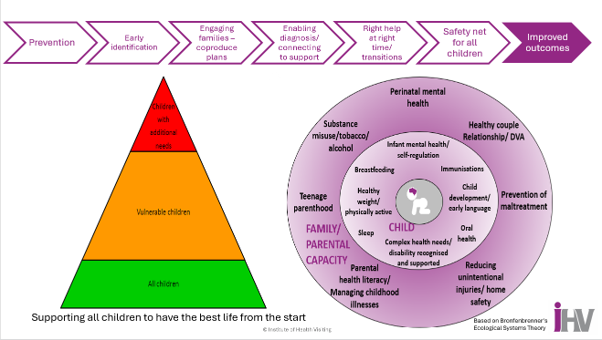
Health visitors and their teams contribute at multiple points across the full SEND pathway (see Figure 1), including:
- Primary prevention – supporting families to reduce risk factors and prevent disease or injury. This includes pregnancy and preconception care to improve outcomes and reduce risks such as foetal alcohol spectrum disorder, preterm birth, and genetic conditions through genomics. During childhood, health visitors help prevent severe traumatic brain injury through accident prevention and safeguarding work, including preventing abusive head trauma ("shaken baby syndrome"), which can result in cerebral palsy.
- Secondary prevention, early identification and needs assessment – reducing the impact of conditions and preventing more severe difficulties from developing. Through their universal and targeted work, health visitors are well placed to identify atypical development, significant impairments and early warning signs of serious conditions. For example, prompt identification and management of neonatal jaundice can prevent avoidable harms including cerebral palsy, hearing loss and learning disabilities. Health visitors can rapidly refer families to specialist services, helping to avoid harmful "wait and see" delays that can have serious consequences if concerns are missed (for example, for babies with atypical motor development ‘red flags’ and suspected cerebral palsy15 early identification and access to treatment by 6-months of age can make a significant difference to outcomes)16.
- Tertiary prevention – supporting families to manage long-term and often complex conditions, improving quality of life and, through their knowledge of local services, connecting them with appropriate specialist services, wider system support and relevant Voluntary, Community and Social Enterprise (VCSE) provision to meet their individual needs.
- Reaching all babies and children with SEND - Effective SEND support depends on services reaching those who need them, and early access can significantly improve outcomes. Health visitors are often parents' first point of contact when concerns arise about a child's development. Some families, particularly the most vulnerable, may be unaware of their child's needs or available support. The longstanding "inverse care law" means those with the greatest need are often least likely to access services. Universal mandated health visiting contacts therefore provide a crucial safety-net, ensuring all babies and young children are seen, including those who may otherwise remain invisible to services.
- Engaging and supporting parents: the importance of continuity of carer - Parents are central to their child's development and engagement with SEND support. Yet, we also know that many face economic, social and health challenges that affect family outcomes. Alongside supporting the child, services must also consider the needs of parents/ primary caregivers and ensure that they are supported to thrive in their role.
Relationship-based care is a defining strength of health visiting17,18,19 and can be particularly important for families of children with SEND. Continuity supports trust, improves communication, facilitates earlier recognition of changing needs, and helps families navigate complex pathways of support.
The identification of SEND can be a particularly challenging time for families, often bringing uncertainty, anxiety and, in some cases, depression20. These pressures may impair parenting ability and can have an immediate and long-term direct impact on the infant’s physical, cognitive, emotional and social development. It is therefore vital that services also support families in their transition to parenthood during their “different journey” – health visitors play a key role in brokering parental engagement and supporting families through this transition, fostering parental engagement and helping parents adapt to their child's individual journey.
A whole-family approach must recognise and respond to the needs of parents and carers as well as the child. Some parents may themselves have mental health needs, be neurodivergent, have a learning disability, or have other communication, cognitive, sensory or literacy needs that affect how they access and engage with services. Services should identify and respond to these needs through accessible communication, reasonable adjustments, continuity of support, and coordinated working across services. Parental neurodivergence or learning disability should not be equated with reduced parenting capacity. Support should be strengths-based, relational, non-stigmatising, value parents' lived experience and expertise, and recognise that difficulties engaging with services may reflect unmet need or barriers to access rather than a lack of commitment or capability.
-
Enabling diagnosis, connecting families to services and support during long waits – Support for babies and young children with SEND and their families should be in place as soon as the early signs are detected – and this includes the period when they are waiting for specialist support and diagnosis. The impact of long waits for assessment, diagnosis and treatment for babies and children can be devastating, and this can be a particularly anxious time for parents.
- Providing targeted support for high-risk groups – Some children are at increased risk of SEND, including those born prematurely and those affected by consanguinity or parental substance misuse. Health visitors can provide enhanced support for these families and coordinate integrated, multi-agency responses where needs are complex. Health visitors are uniquely placed to support the early development of children born prematurely, providing continuity as families move between neonatal, outreach and hospital services, and support throughout the early years. The longitudinal nature of health visiting was recognised in the 2024 House of Lords Preterm Birth Inquiry, Reducing Risks, Improving Lives, which acknowledged that many needs of children born prematurely are only identified through monitoring progress over time.
Figure 1: The role of health visitors across an integrated SEND pathway of provision
Building an Effective Early Years SEND System
The SEND crisis cannot be solved by any single organisation. Children and families need a clearly defined, integrated pathway that brings together health, education and social care around shared outcomes. The iHV recommends the development of...
The SEND crisis cannot be solved by any single organisation. Children and families need a clearly defined, integrated pathway that brings together health, education and social care around shared outcomes. The iHV recommends the development of:
A National Early Years SEND Framework
A national framework to:
- Define the role of all agencies.
- Clarify responsibilities and accountability.
- Reduce duplication and service gaps.
- Support workforce and financial planning.
- Promote consistency – ending the postcode lottery.
Integrated Local Pathways
Local systems to:
- Establish clear referral and support pathways.
- Facilitate coordinated assessment and care planning.
- Promote information sharing.
- Ensure health bodies (including health visiting) fulfil their Section 23 SEND duty21, notifying the local authority when a child has, or is likely to have, SEND, involving parents in the process to support assessment, planning and provision of support.
- Support smoother transitions to education settings and school.
Family-Centred Care
SEND provision requires a shift from a deficits-based model to a strengths-based approach, focused on:
- What matters to the child and family.
- Building on family strengths.
- Co-production and shared decision-making. This begins with the process of SEND reform itself, which needs to be co-produced with families and frontline practitioners.
- Supporting parental wellbeing alongside child development.
Strengthening Health Visiting for SEND
Health visitors can make an important contribution to improving outcomes for children with SEND, but this depends on adequate workforce capacity, consistent commissioning and sufficient investment to support high-quality prevention, assessment and early intervention...
Health visitors can make an important contribution to improving outcomes for children with SEND, but this depends on adequate workforce capacity, consistent commissioning and sufficient investment to support high-quality prevention, assessment and early intervention.
The recently refreshed Healthy Child Programme in England (and similar programmes in the devolved UK nations) offers a significant opportunity to improve the quality and consistency of developmental assessment and surveillance, reduce unwarranted variation in practice across the UK, and support earlier identification of need. Assessment approaches should recognise the complexity of child development and support professional observation and clinical judgement alongside standardised measures.
Universal access to health visiting reviews
An effective early years SEND system depends on every child receiving the full programme of mandated health visiting reviews. Universal health visiting reviews currently provide the only means of proactively and systematically reaching all babies and young children at regular touchpoints in the early years. The purpose of the health visiting review is to complete a holistic assessment of a child's health and wellbeing, taking account of the context in which they live and wider family factors that can have a significant impact on outcomes. As such, they provide critical opportunities for developmental surveillance, early identification of emerging needs, parental support, and timely intervention, alongside referral to specialist or community services.
However, growing workforce pressures23 are contributing to increasing numbers of missed contacts, with England falling behind the other UK nations. When children miss developmental reviews, opportunities for prevention, early identification and timely intervention may be lost, particularly during the critical early years when support can have the greatest impact. The consequences are likely to be felt most acutely by children and families experiencing disadvantage, increasing the risk of unmet need and widening inequalities in access to support and outcomes.
Ensuring equitable access to the full Healthy Child Programme is therefore fundamental to improving SEND outcomes, supporting earlier identification and intervention, and reducing health inequalities for children and families.
High-quality assessments – use of assessment tools, face-to-face contacts and home visiting
Through their universal reach, trusted relationships with families and specialist expertise in child development and family health and wellbeing, health visitors are uniquely placed to identify emerging concerns during the earliest years of life.
Assessment should be viewed as an ongoing process rather than a single ‘snapshot’, recognising that developmental differences may emerge over time and present differently across children and contexts. Earlier and more accurate identification of SEND requires nationally consistent, evidence-based approaches to developmental surveillance and assessment that support the recognition of need at the earliest opportunity.
Effective early identification of SEND requires high-quality holistic assessment that goes beyond the use of screening tools and population measures alone. While structured tools can support assessment, they should be used alongside skilled observation, professional curiosity, clinical judgement and meaningful engagement with parents and carers.
Holistic health and development assessment is a skilled clinical process, not simply the administration of an assessment tool or child development population measure24. While these tools can support structured conversations, they have recognised limitations in accurately identifying need, with evidence that assessment tools such as the Ages and Stages Questionnaire (ASQ) can provide useful indicators of development but should not be used in isolation. Evidence from the development of the Early Language Identification Measure (ELIM) highlighted the need for approaches that combine structured measures with practitioner observation, parental insight and professional judgement25.
Effective assessment requires health visitors to integrate information from direct observation, clinical expertise, parental insight, family circumstances and knowledge of the child and family context gathered over time, rather than a single snapshot. This holistic approach is essential to recognise developmental differences, understand the child's wider context and identify opportunities for early support.
Face-to-face contact remains the cornerstone of effective health visiting practice. Direct observation enables health visitors to assess parent-child interaction, communication, play, behaviour and developmental skills, while also considering broader influences on outcomes, including parental wellbeing, family relationships, the home environment and safeguarding needs. The effectiveness of assessment is enhanced by home visiting - enabling direct observation of the child within the context of their family and everyday environment, strengthening professional judgement and supporting earlier identification of need26. For children with emerging or identified SEND, this is particularly important, as developmental differences may be subtle, evolve over time, or be influenced by environmental factors.
Digital approaches can complement service delivery and improve flexibility, but they cannot replace face-to-face universal holistic assessments. Maintaining face-to-face provision within the Healthy Child Programme is essential to support early identification, informed clinical decision-making, timely intervention, equitable access to services and child safeguarding. Learning from the UK Covid-19 Inquiry27 provides a stark reminder of the increased risks and harms of online assessments.
Assessment approaches should be validated for UK populations, culturally appropriate and sufficiently sensitive to identify developmental differences across diverse communities. Assessment should support the early identification of need and timely access to support, recognising that intervention should be needs-led and not contingent on a diagnosis.
Continuity of care
Relationship-based care, rather than task-based care, is a defining feature of effective health visiting practice and is more effective, with good evidence that this leads to better identification of need, improved coordination of care, parental engagement and uptake of health-promoting messages29 – this is particularly important for families with SEND, as well as under-served communities30.
Continuity of practitioner enables trusting relationships to develop between families and health visitors - supporting earlier identification of concerns, stronger parental engagement and more effective care coordination. Through ongoing contact, health visitors are able to build a deeper understanding of the child's development, family circumstances, strengths and emerging needs over time.
For children with SEND, continuity can be particularly important where developmental differences may emerge gradually or present in less obvious ways. A health visitor who knows the child and family is better placed to recognise changes in development, identify patterns over time, and respond to parental concerns. Continuity also supports more meaningful developmental assessment, reducing reliance on single-point observations and enabling professional judgement to be informed by longitudinal knowledge of the child.
Families frequently report the need to repeat their story to multiple professionals as a source of frustration and stress31. Continuity can improve family experience by reducing duplication, strengthening trust, and ensuring support is coordinated across services. This is especially important for families navigating complex systems, multiple appointments and ongoing involvement from health, education and specialist SEND services.
Investment in workforce capacity is essential to enable continuity of care and preserve the relationship-based practice that underpins effective early identification, intervention and support.
Expanding the universal pathway
Improved SEND outcomes require more opportunities for prevention, developmental surveillance and timely intervention during the critical early years. Current gaps within the Healthy Child Programme mean that some developmental differences may not be identified until children approach school age, potentially delaying access to assessment, support and early intervention.
An expanded health visiting pathway, including additional targeted support for children known to be at higher risk of SEND and an additional review at around 3½ years, would provide important opportunities to assess developmental progress, review emerging concerns and identify children whose needs may become more apparent during the preschool years.
An additional universal review at 3½ years would support school readiness assessment, enabling effective transition planning and timely discussion with parents and carers about any additional support that may be required. This would support earlier referral to appropriate services where needed, facilitate multi-agency planning, and help ensure that reasonable adjustments and support are in place before school entry.
Strengthening developmental surveillance within the universal pathway has the potential to reduce inequalities in identification, improve access to timely intervention and ensure that children with emerging or identified SEND receive the right support at the earliest opportunity. By identifying needs earlier and improving transition planning, an expanded pathway could contribute to better long-term educational, health and wellbeing outcomes.
Seamless support: Integration with Family Hubs, Neighbourhood health and school nursing
Effective early years systems are characterised by strong partnerships and clear pathways between health visiting services, Family Hubs, education, primary care, specialist SEND services and school nursing. For families of children with emerging or identified SEND, integrated working can reduce fragmentation, improve communication between professionals, and support coordinated care.
Realising the potential of Neighbourhood Health and Family Hubs requires integrated SEND pathways that bring together health, education, social care and voluntary sector partners, with health visiting providing a vital bridge between families and the wider system of support.
Health visitors play a key role within Family Hubs, contributing their expertise in child development, safeguarding, infant mental health and early intervention. Co-location, shared pathways, joint assessments and multidisciplinary working can strengthen collaboration between universal and specialist services, improving the timeliness and effectiveness of support.
These arrangements should enable families to access information, advice and support through a coordinated system rather than navigating multiple disconnected services. Health visitors are well placed to help families understand what support is available, connect them with the right services, and reduce the burden on parents and carers of navigating complex pathways and systems. Families should experience seamless care that values parental expertise, supports informed decision-making, and responds to the needs of the whole family.
A whole-system approach supports better transition to school and maximises the role of school nurses within the SCPHN 0-19 workforce. Effective collaboration and transfer of care between health visiting and school nursing services help ensure that children, young people and families continue to receive timely support as their needs change. School nurses are uniquely placed to build on the foundations established in the early years, promoting physical health, emotional wellbeing and resilience through childhood and adolescence. When adequately resourced, they also have an important role in supporting the future generation of parents and contributing to improved population health outcomes across the life course.
Workforce: The Foundation for Improvement
Having the right practitioner with the right skills at the right time is the bedrock of safe and effective care. This is particularly important when skills are needed for assessment, healthcare planning, risk management and child safeguarding which involve “pulling together the disparate parts of the jigsaw of a child’s life”...
Having the right practitioner with the right skills at the right time is the bedrock of safe and effective care. This is particularly important when skills are needed for assessment, healthcare planning, risk management and child safeguarding which involve “pulling together the disparate parts of the jigsaw of a child’s life”32. The workforce must be recognised as “the biggest safety-critical asset that we have”33. Investing in staff development may seem counterintuitive when funds are tight, but equipping staff with the right skills can lead to better outcomes and reduced costs in the longer term.
Rebuilding workforce capacity
The quality of support that children and families receive depends on the capacity, capability and expertise of the workforce delivering the services. Early identification, effective assessment, care coordination and timely intervention all rely on having the right practitioner with the right skills at the right time.
The loss of more than 40% of health visitors since 2015 has significantly constrained the ability of services to deliver both universal and targeted support, contributing to considerable and unwarranted variation in the level of support available to families across England34. As a result, access to early identification, preventative support and coordinated SEND pathways is too often determined by where a child lives rather than their level of need, leading to inconsistent support and widening health inequalities.
Children with SEND and their families are disproportionately affected when services lack the capacity to undertake comprehensive assessments, coordinate care, provide specialist expertise and advocacy.
Sustainable service delivery requires sufficient numbers of health visitors and skill mix practitioners, supported by demand-driven workforce modelling and long-term workforce planning that reflects population need, rising SEND prevalence, and the expectations set out within the Healthy Child Programme. Investment in the health visiting workforce is essential to ensure that every child receives their universal reviews, that families can access timely support, and that practitioners have the capacity to provide targeted interventions for those with additional and complex needs.
Retaining expertise
Workforce sustainability depends not only on recruitment but also on retaining experienced practitioners and creating opportunities for professional development. Career pathways, preceptorship, clinical supervision, continuing professional development, including leadership development and flexible routes into and back into practice, are all important in maintaining workforce capacity and expertise.
Workforce shortages, increasing demand, and resource constraints prevent practitioners from delivering the level of care they are trained and want to provide. The result can be moral distress, burnout, reduced job satisfaction and sub-standard care. These pressures create further challenges for recruitment and retention, leading to workforce shortages and placing additional strain on services.
A sustainable workforce also requires investment in specialist roles that provide leadership, education, supervision, quality improvement and service development. Specialist practitioners help build capability across the wider workforce, support the implementation of evidence-based practice and strengthen integrated working across health, education and social care. Retaining this expertise is essential if services are to respond effectively to increasing demand and growing complexity.
Developing a SEND-confident workforce
In line with the SEND Code of Practice, SEND is everybody's business. Every practitioner working with babies, children and families should have the knowledge, skills and confidence to identify emerging needs, listen to parental concerns, contribute to early support and work collaboratively across agencies. SEND awareness, early identification and inclusive practice should be embedded across universal, targeted and specialist services.
Achieving this requires access to ongoing education, training, supervision and specialist SEND leadership, enabling practitioners to undertake effective assessment, coordinate support, manage complexity and contribute confidently within multidisciplinary teams. A SEND-confident workforce is fundamental to delivering high-quality care, improving outcomes and reducing inequalities for children and families.
Strengthening health visiting leadership and expertise in SEND
Every health visiting service should have access to appropriately trained specialist health visitor SEND leadership, with sufficient capacity to provide clinical leadership, supervision, workforce development, quality assurance, service improvement, and strategic multi-agency pathway development.
Specialist health visitors for SEND are experienced health visitors (SCPHN-HV) who provide expert leadership and support the delivery of evidence-based, equitable and family-centred care, helping to ensure that children receive the right support at the right time.
As strategic leaders, they work across organisational boundaries to strengthen integrated pathways between health, education and social care, reduce variation in practice, improve family experience and influence service development. They provide specialist consultation, supervision and workforce education, supporting practitioners to identify emerging needs, manage complexity and make informed decisions. Through their involvement in research, quality improvement, policy development and system leadership, they help drive sustainable improvements in outcomes for children with SEND and their families.
Importantly, Specialist Health Visitors for SEND do not replace the role of the health visitor. Health visitors remain central to the delivery of the Healthy Child Programme. Specialist SEND roles strengthen this contribution by building workforce capability and supporting the development and delivery of high-quality, evidence-informed health visiting services and integrated SEND pathways.
Specialist Health Visitors for SEND play a key role in creating and sustaining workforce capability through training, supervision, mentorship and quality improvement, ensuring that SEND expertise is embedded at every level of service delivery rather than concentrated within a small number of specialist posts.
They also play a critical role in advocating for babies, children and families, embedding co-production, promoting inclusion, supporting reasonable adjustments, reducing health inequalities, and ensuring that the voices of children and families influence service design, commissioning and continuous improvement.
Funding, Accountability and National Leadership
The current SEND system is characterised by fragmented responsibilities, variable provision and significant geographical variation in access to support...
The current SEND system is characterised by fragmented responsibilities, variable provision and significant geographical variation in access to support. There is currently no comprehensive national dataset that shows how many babies and children are born with, or develop, SEND or probable SEND during the early years - when needs are first identified, what support is provided, or what outcomes are achieved. Existing information is fragmented across health, education, social care and local authority systems, with much national SEND reporting becoming visible only when children enter education or receive an Education, Health and Care Plan (EHCP). This limits population-needs assessment, workforce planning, commissioning, evaluation of early intervention, and accountability for children who remain below diagnostic or statutory thresholds.
Achieving sustainable improvement requires long-term investment, stronger accountability, and better data on children with SEND - to support a more coherent national approach to SEND provision and impact measurement.
Reform Principles:
- Early: Giving babies and young children equal priority within SEND policy and reform, with a focus on prevention, early identification and early intervention in the earliest years to improve outcomes and reduce future demand on specialist services.
- National consistency, local empowerment: Reducing variation in outcomes requires greater consistency in SEND provision for babies, children and families, regardless of where they live. National standards, accountability and integrated commissioning frameworks should set out the support and provision ordinarily available to all babies, young children and families with SEND - reducing unwarranted variation and improving outcomes. Within this framework, local flexibility should enable integrated services that respond to local need while promoting earlier intervention, coordinated support and equitable outcomes.
- Fair: Urgent investment across the whole SEND system is needed to meet rising need, deliver national standards and reduce inequalities. Equitable provision depends on funding models that reflect population need and changing demand. This must include ring-fenced funding for health visiting and a workforce plan to ensure all families can access this vital universal service and core component of early SEND identification and support.
- Effective: SEND support should be evidence-based and focused on improving outcomes, taking a whole-family approach that supports parents and carers alongside children from pregnancy onwards. This requires a skilled and sustainable workforce with the knowledge, training and capacity to identify needs early and provide timely, effective support. High-performing systems are characterised by a culture of learning, evaluation and improvement. Data, audit, research, service-user feedback and co-production all play an important role in driving improvement and ensuring services remain responsive to the needs of children and families. A more coherent early years SEND data landscape is also needed to strengthen population-needs assessment, service planning, evaluation and accountability for outcomes.
- Shared responsibility: Integrated care pathways centred on babies, children and families, bringing together health, education, and community services with shared accountability for outcomes - and health visiting playing a key role in early identification, coordinated support and improved outcomes for children with SEND and their families. Accountability mechanisms should focus not only on compliance, but also on outcomes, family experience, and the quality of seamless support/ integrated working.
iHV Policy Priorities for health visiting
The Institute of Health Visiting recognises that addressing the SEND crisis requires action across the whole system. As part of this wider programme of reform, the iHV calls for a renewed commitment to strengthening the contribution of health visiting to early years SEND provision through...
The Institute of Health Visiting recognises that addressing the SEND crisis requires action across the whole system. As part of this wider programme of reform, the iHV calls for a renewed commitment to strengthening the contribution of health visiting to early years SEND provision through:
- Rebuilding the health visiting workforce through a fully funded workforce strategy that restores capacity, reduces unwarranted variation and ensures every family has access to a universal health visiting service, with additional targeted and specialist SEND support proportionate to need. Investment should also support continuity of practitioner and the relational model of care that underpins effective assessment, parental engagement, care coordination and early intervention.
- Delivering universal access to the Healthy Child Programme, ensuring all children receive the full programme of health visiting reviews to support prevention, developmental surveillance, early identification and timely intervention.
- Strengthening developmental assessment and early identification through evidence-based approaches that combine professional judgement, holistic assessment, face-to-face contact and home visiting alongside the appropriate use of assessment tools.
- Expanding the universal and targeted health visiting pathway, including enhanced support for children at increased risk of SEND and an additional universal review at around 3½ years to support school readiness, transition planning and earlier access to support.
- Developing a SEND-confident health visiting workforce, supported by ongoing education, supervision, professional development and specialist health visitor SEND leadership to strengthen capability across universal, targeted and specialist services, and to sustain relationship-based care for children and families.
- Embedding health visiting within integrated Family Hub and Neighbourhood Health models, with clear pathways across health, education, social care and community services and shared accountability for outcomes. Ensure that SEND pathways are accessible to parents and carers with additional needs, including those who are neurodivergent, have a learning disability, mental health needs, sensory needs or communication differences, with a clear expectation that reasonable adjustments will be identified, recorded, shared and reviewed.
- Providing stronger national leadership, accountability and investment for early years SEND, including a National Early Years SEND Framework, integrated commissioning, improved data systems and sustainable funding for prevention, early intervention and health visiting.
References
- House of Commons Education Committee. Solving the SEND Crisis: Fifth Report of Session 2024-25; 2025. https://committees.parliament.uk/publications/49536/documents/265373/default/
- House of Commons Education Committee. Solving the SEND crisis: Government Response; 2026. https://committees.parliament.uk/publications/53609/standard/pdf/
- National Audit Office. Support for children and young people with special educational needs. London: National Audit Office; 2024 [cited 25 August 2026]. Available from: https://www.nao.org.uk/reports/support-for-children-and-young-people-with-special-educational-needs/
- Horton A., Franklin J., Rebalancing the system: Children’s services spending, 2011-2025, PBE (June 2026). https://pbe.co.uk/wp-content/uploads/2026/06/Rebalancing-theSystem_Childrens-Services-spending-2011-25_FINAL.pdf
- Morton A. The role of the health visitor: where are we now? Paediatrics and child health, volume 34, Issue 7, p. 234-238. [cited 25 August 2026] Available from: https://www.sciencedirect.com/science/article/abs/pii/S1751722224000568
- National Children’s Bureau. The importance of health visiting for babies and their families: Evidence from the A Better Start Programme, 2026. https://www.ncb.org.uk/sites/default/files/uploads/files/Policy%20briefing_health%20visiting.pdf
- UNICEF UK. Early moments matter. 2022. [accessed 31 January 2025] Available from: https://bit.ly/3RQdqPb
- Department of Health and Social Care. Children;s public health nursing: workforce and activity, 2025; 2026. https://www.gov.uk/government/statistics/childrens-public-health-nursing-workforce-and-activity-2025
- Institute of Health Visiting. Government’s own data confirm scale of health visiting workforce crisis, yet no plan has been set out to address it; iHV news story, 2026. https://ihv.org.uk/news-and-views/news-listing/2026/september/government-s-own-data-confirm-scale-of-health-visiting-workforce-crisis-yet-no-plan-has-been-set-out-to-address-it/
- House of Commons Education Committee. Solving the SEND crisis: Government Response; 2026. https://committees.parliament.uk/publications/53609/standard/pdf/
- National Institute for Health and Care Excellence (NICE). Developmental follow-up of children and young people born preterm [NG72]. London: NICE; 2017. [cited 25 August 2026]. Available from: https://www.nice.org.uk/guidance/ng72
- Institute of Health Visiting. What do parents want from a health visiting service? 2020. https://ihv.org.uk/media/wdqha0pb/hv-vision-channel-mum-study-final-version-24120.pdf
- Disabled Children's Partnership. Disabled Children's Partnership response to SEND Reform: Putting Children and Young People First. 2026. Available from: https://disabledchildrenspartnership.org.uk/wp-content/uploads/2026/05/Disabled-Childrens-Partnership-response-to-SEND-Reform-putting-children-and-young-people-first.pdf
- Conti, G. and Weber Costa, G.. Written evidence submitted to UK Parliament Inquiry on early years services by University College London (FTDOO69), 2025. Available from: https://committees.parliament.uk/writtenevidence/140707/pdf/
- Action Cerebral Palsy. If in Doubt, Check it Out. 2025. [cited 25 August 2026]. Available from: https://actioncp.org/signs/
- Novak I, Morgan C, Adde L, Blackman J, Boyd RN, Brunstrom-Hernandez J, et al. Early, Accurate Diagnosis and Early Intervention in Cerebral Palsy: Advances in Diagnosis and Treatment. JAMA Pediatrics. 2017;171(9):897-907. https://jamanetwork.com/journals/jamapediatrics/article-abstract/2636588
- Harron K. et.al., How should policymakers, funders, and research teams mobilize to build the evidence base in universal early years services? 2024. https://pubmed.ncbi.nlm.nih.gov/39655521/
- Lawley S., Experiences of the health visiting service through parents’ own words. Journal of Family and Child Health, Vol 3 (8). https://doi.org/10.12968/jfch.2026.0072
- Cowley S, Whittaker K, Malone M, Donetto S, Grigulis A, Maben J. Why Health Visiting? A review of the literature about key health visitor interventions, processes and outcomes for children and families. London: King's College London; 2015.
https://www.researchgate.net/publication/261773587 - Mugweni E. et al., Improving the way healthcare professionals deliver different news to families during pregnancy or at birth: a qualitative study. 2021. [cited 25August 2026]. Available from: https://pmc.ncbi.nlm.nih.gov/articles/PMC8101073/
- UK Parliament. Children and Families Act 2014, Section 23: Duty of health bodies to bring children with special educational needs or disabilities to the attention of the local authority [Internet]. London: The Stationery Office; 2014 [cited 2026 Oct 21]. Available from: https://www.legislation.gov.uk/ukpga/2014/6/section/23
- Institute of Health Visiting. UK Health Visiting Policy; iHV web resource [accessed 10/10/2026]. https://ihv.org.uk/policy/uk-health-visiting-policy/
- Institute of Health Visiting. Government’s own data confirm scale of health visiting workforce crisis, yet no plan has been set out to address it, September 2026. https://ihv.org.uk/news-and-views/news-listing/2026/september/government-s-own-data-confirm-scale-of-health-visiting-workforce-crisis-yet-no-plan-has-been-set-out-to-address-it/
- Office for Health Improvement and Disparities. Child development outcomes data. https://www.gov.uk/government/statistics/child-development-outcomes-data-for-2025-to-2026
- Law J., et.al., Identifying and Supporting Children’s Early Language Needs, 2020. Identifying and Supporting Children's Early Language Needs - ePrints - Newcastle University
- Cowley S, Whittaker K, Malone M, Donetto S, Grigulis A, Maben J. Why Health Visiting? A review of the literature about key health visitor interventions, processes and outcomes for children and families. London: King's College London; 2015.
https://www.researchgate.net/publication/261773587 - Morton A., Written statement for UK Covid-19 Inquiry, module 8, 2025. https://covid19.public-inquiry.uk/documents/inq000587870-witness-statement-of-alison-morton-provided-on-behalf-of-institute-of-health-visiting-dated-26-06-2025/
- Leary A. The healthcare workforce should be shaped by outcomes rather than outputs. 2025. [accessed 1 February 2025]. Available from: https://blogs.bmj.com/bmj/2019/05/31/alison-leary-the-healthcare-workforce-should-be-shaped-by-outcomes-rather-than-outputs/
- Institute of Health Visiting. Health visiting in England: A vision for the future. 2019. https://ihv.org.uk/media/h3wfffh3/71119_health_visiting_in_england_vision_final_version.pdf
- Unicef-UK, NSPCC. Opening Doors: Access to early childhood services for families impacted by poverty in the UK, 2024. [accessed 10/10/2026]. Available from: https://learning.nspcc.org.uk/media/l2jimcnr/opening-doors-family-poverty-research-report.pdf
- HM Government. The Best Start for Life: A vision for the 1,001 Critical Days, 2021. https://assets.publishing.service.gov.uk/media/605c5e61d3bf7f2f0d94183a/The_best_start_for_life_a_vision_for_the_1_001_critical_days.pdf
- The Child Safeguarding Practice Review Panel. Child Protection in England. [Accessed 10/10/2026] Available from: https://assets.publishing.service.gov.uk/media/628e262d8fa8f556203eb4f8/ALH_SH_National_Review_26-5-22.pdf
- Leary, A. in Ford, M. Workforce must be seen as ‘the biggest safety critical asset we have’. Nursing in Practice. 2023. [Accessed 10/10/2026] Available from: http://bit.ly/3PCdL7d
- Department of Health and Social Care. Official statistics: Children’s public health nursing: workforce and activity, 2026. 17 September 2026. https://www.gov.uk/government/statistics/childrens-public-health-nursing-workforce-and-activity-2025
Acknowledgements
Authors: Freeman, N., Jacques, K., Rew, M. and Morton, A.
With thanks to the Institute of Health Visiting SEND Special Interest Group.
Last updated 3 November 2026
See all our position statements
Position statements