Wednesday, 11 November 2026
The Princess of Wales has visited health visitors in Hampshire to see how specialist training in the Alarm Distress Baby Scale (ADBB) is helping practitioners identify babies who may benefit from additional support, strengthening early relationships and supporting infant mental health.
During her visit to The Chase Community Hospital in Bordon, Hampshire, The Princess met health visitors from Hampshire and Isle of Wight Healthcare NHS Foundation Trust, who have been trained to use the evidence-based ADBB tool as part of their work with babies and families.
The Alarm Distress Baby Scale (ADBB) is an evidence-based observational tool that helps healthcare and childcare professionals recognise early signs of social and relational withdrawal in infants. Through observing babies' eye contact, facial expressions, vocalisations and activity levels, health visitors can develop a better understanding of babies' social behaviour, explore their cues with parents and carers, and identify when further assessment or support may be needed.
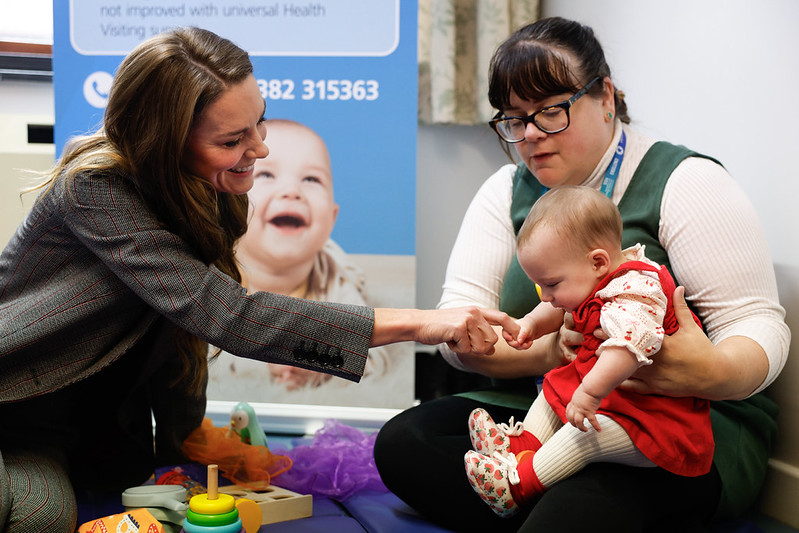
The Princess first observed the ADBB in practice during a visit to Denmark with The Royal Foundation Centre for Early Childhood in February 2022. Following this, she asked The Centre to explore how the approach could be introduced in the UK. Since then, The Centre has worked with the Institute of Health Visiting (iHV) to support the development and expansion of ADBB training to bring the benefits of the approach to families across the UK.
The Chase Community Hospital is home to one of three health visiting teams from Hampshire and Isle of Wight Healthcare NHS Foundation Trust that took part in the initial pilot. Since then, the Trust has trained more specialist health visitors and staff within its Growing Little Minds Specialist Health Visiting Team in ADBB. It has also committed to rolling out the training to its remaining 12 health visiting teams across the county, enabling a reach of nearly 25,000 children under the age of one in Hampshire.
During the visit, The Princess met families who had received additional support following an ADBB assessment and heard about the difference this had made. She also joined discussions with healthcare professionals and NHS representatives, including colleagues from North Tyneside Children's Public Health Service and South Lanarkshire Social Care Partnership, who are exploring how the approach could be introduced within their own services.
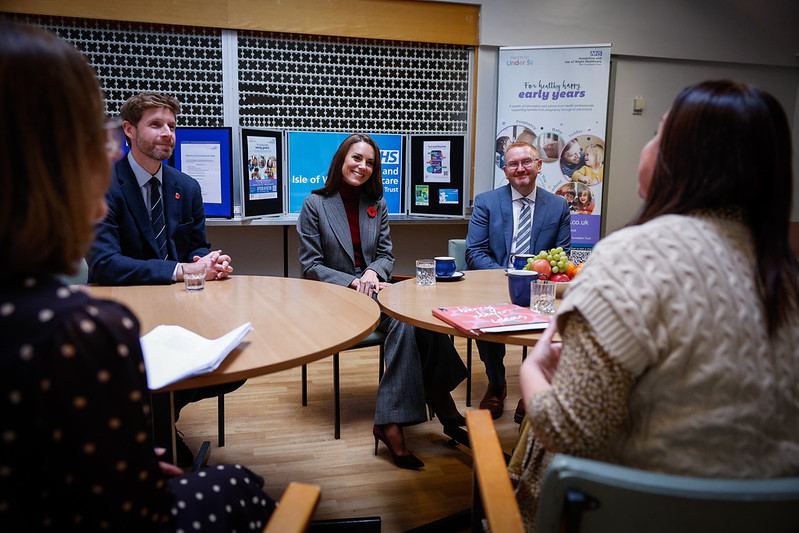
The Princess was accompanied by: Christian Guy, Executive Director of The Royal Foundation Centre for Early Childhood; Alison Morton OBE, Chief Executive of the Institute of Health Visiting; and Professor Jamie Waterall OBE, Deputy Chief Public Health Nurse for England.
Alison Morton OBE, Chief Executive of the Institute of Health Visiting, said:
“It was wonderful to welcome The Princess of Wales to Hampshire today and share how health visitors are using the ADBB tool to strengthen their assessment of infant social and emotional wellbeing.
“Her Royal Highness's knowledge, passion and commitment to improving outcomes in the early years continue to shine a spotlight on the vital support that health visitors provide for babies and families.
“The Institute of Health Visiting was proud to support the pilot and evaluation of ADBB, which showed it can be effectively incorporated into routine contacts with families. There has been strong national interest in learning from Hampshire's experience, and we look forward to supporting the wider rollout of ADBB. By enabling earlier identification and intervention, it can make a real difference for babies and families."
Alison Morton OBE
Supporting babies' social and emotional development is foundational to The Centre's work, reflecting evidence of the importance of the earliest years of life in shaping future health, wellbeing and relationships. The ADBB programme forms part of The Centre's wider efforts to strengthen the early years workforce and support parents and carers in nurturing babies' and young children's social and emotional development.
Christian Guy, Executive Director of The Royal Foundation Centre for Early Childhood, said:
"By giving health visitors the tools and confidence to recognise when a baby may need extra support, we can help parents and carers better understand their baby's cues and nurture those vital early relationships which we know can have such a positive impact on life-long wellbeing.
"We are proud to support the next stage of this work with the Institute of Health Visiting, to reach more families across the UK, helping parent infant connection during the foundational years of life."
Christian Guy
Investing in the future of ADBB training
The visit marks an important milestone in the continued development of the ADBB programme. Following two successful pilot phases involving ten NHS sites, The Royal Foundation Centre for Early Childhood announced a further investment of £250,000 over three years to support wider adoption of the approach.
This funding will enable the iHV to develop commissioning guidance and training resources, alongside establishing a three-year Community of Practice - this will provide ongoing learning, supervision and peer support for professionals implementing ADBB within their services.
The investment builds on positive findings from two Centre-funded study phases: an initial feasibility study involving two NHS trusts, followed by a second phase across eight UK sites.
Acknowledgements
We would like to extend our thanks to Hampshire and Isle of Wight NHS Foundation Trust for hosting the event – and also to the families who met with The Princess to share their experiences of ADBB and the additional support they received following an ADBB assessment.
Thanks also to colleagues from North Tyneside Children's Public Health Service and South Lanarkshire Social Care Partnership who came to the event to hear more about implementing ADBB in their area.